
 California Highways:
Click here for a key to the symbols used. An explanation of acronyms may be found at the bottom of the page.
 Routing
 No current routing.
 Post 1964 Signage History
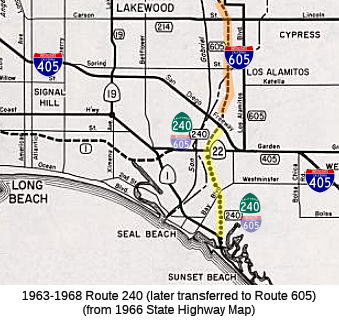
 ▸In 1963, Route 240 was defined as “Route 1 near Seal
Beach to Route 405.”
During the 1964 State Highway Renumbering, Route 35 was repurposed over
what was Sign Route 5 in the Santa Cruz Mountains. The entirety of
LRN 170 and the San Gabriel River Freeway was broken up into three
designations. Chargeable I-605 was from "Route 405 to Route 10 near
the San Gabriel River." The planned San Gabriel River Freeway south
of I-405 to Route 1 became Route 240. The planned San Gabriel River
Freeway north of I-10 to I-210 and the Foothill Freeway became Route 243. Until the new I-605 was completed, the previous surface route
of the original Sign Route 35 was temporarily designated as LRN 605.
In 1964, construction of the Route 240 portion of the San Gabriel River
Freeway to Route 22 was partially financed, with a planned completion in
late 1966.
(Source: Gribblenation Blog (Tom Fearer), "Former California State Route 240", 4/5/2023)
▸In 1968, Chapter 282 repealed the definition of Route 240, transferring the routing to Route 605.
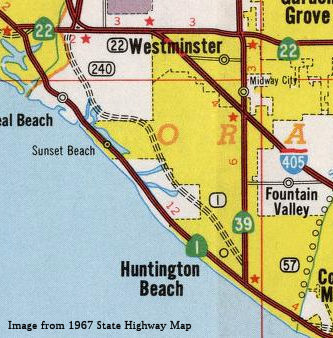 The Pacific Coast Freeway in Orange County, as of 1966, turned south from Route 22 on
7th Street, skirting the wetlands inland from Seal Beach, and
passing by Huntington Harbor to the then-proposed Route 39 freeway, which
extended due N-S between Beach Blvd. and Golden West Avenue. The likely
rationale behind this odd routing was that the portion between the
I-405/I-605/Route 22 interchange and Route 39 needed to avoid Huntington
Harbor; hence, it stayed well inland. When it intersected the Route 39
freeway alignment, it turned south following the Route 39 trajectory for a
mile or so before turning SE again to parallel Pacific Coast Highway
(PCH)—but slightly inland to avoid (a) the wetlands immediately
north of PCH and (b) the Edison power plant in SE Huntington Beach. Prior
to the mid '70's, when the deletions took place, the Route 1 adopted
alignment in L.A. and Orange counties was hardly linear in nature; it
twisted around to avoid obstacles along or near its projected alignment
(refineries in Torrance and Wilmington, business districts and CSULB in
Long Beach, Huntington Harbor and the more densely-developed parts of
Huntington Beach, etc.). Interestingly, the original route that was
formally adopted in the '60's showed the adopted route directly south of
the I-405/I-605/Route 22 interchange as Route 240; it is unclear if Route 1 was to remain on PCH between Route 22 and Route 240—or whether any
conceptual freeway corridor paralleling PCH was under study or discussion;
no map ever showed a future alignment anywhere near that section of PCH.
[A study the City of Long Beach did in the mid-'70s regarding this
corridor (in which they recommended the Division of Highways drop the
proposed freeway route), Route 1 would have used the Route 240 corridor.
An alternate routing that used the PCH corridor between 7th
Street and Seal Beach would have been feasible, since there was almost no
development along that corridor until the mid-'70s. ] It would have likely
been a non-starter in any case, since it would have passed through Belmont
Shores, a proverbial "poster child" for upscale NIMBY activity. This
arrangement was different by 1971, when Route 243 (the original
designation of the northern extension of I-605 between I-10 and I-210) was
added to the Interstate system that year while the extension was under
construction (it was never signed as anything but I-605); Route 240 also
disappeared that year, replaced by Route 1. The original adopted route did
pass through the US Navy facility, which at that time contained the
wetlands yet to be protected by the future Coastal Commission. But any
activity toward development of this alignment was dead by the late '70's
(Gianturco + Coastal Commission = no new freeways anywhere near the
coast). It's probable that the section through Navy land was never
formalized by an agreement between the two entities (Navy & the
Division of Highways), so it was likely left off the 1969 state map until
such an accord could be reached—a point made moot by the overall
route deletion a few years later. The 1981 map's depiction of the corridor
was likely due to mis-or non-communication between the Gousha researchers
and state agencies, since by that time the deletion of both the Route 1
and Route 39 freeways had taken place. The whole notion of deploying a
freeway through Navy territory, coastal wetlands, and anywhere in the
vicinity of Huntington Harbor always seemed to be an exercise in futility.
Even before the mass adopted-route deletions of 1978-82, the only viable
freeway arrangement in the area was to let traffic remain on I-405 to the
Route 39 freeway alignment, and take it down to/near the beach from there.
Obviously even that concept would have been dead meat by the end of the
'70's. In any case, all of these routes, along with the adopted section of
the Route 39 freeway between Route 1 and I-5 near Buena Park was deleted
soon after the Long Beach segment. The Route 1 freeway would have veered
inland near Fountain Valley, and would have intersected Route 55 in Costa
Mesa right about 19th Street, where the current Route 55 freeway ends.
Curiously, the original projected path east of there is similar to the
present location of the Route 73 toll road; both closely bypassed UC
Irvine to the south of campus.
The Pacific Coast Freeway in Orange County, as of 1966, turned south from Route 22 on
7th Street, skirting the wetlands inland from Seal Beach, and
passing by Huntington Harbor to the then-proposed Route 39 freeway, which
extended due N-S between Beach Blvd. and Golden West Avenue. The likely
rationale behind this odd routing was that the portion between the
I-405/I-605/Route 22 interchange and Route 39 needed to avoid Huntington
Harbor; hence, it stayed well inland. When it intersected the Route 39
freeway alignment, it turned south following the Route 39 trajectory for a
mile or so before turning SE again to parallel Pacific Coast Highway
(PCH)—but slightly inland to avoid (a) the wetlands immediately
north of PCH and (b) the Edison power plant in SE Huntington Beach. Prior
to the mid '70's, when the deletions took place, the Route 1 adopted
alignment in L.A. and Orange counties was hardly linear in nature; it
twisted around to avoid obstacles along or near its projected alignment
(refineries in Torrance and Wilmington, business districts and CSULB in
Long Beach, Huntington Harbor and the more densely-developed parts of
Huntington Beach, etc.). Interestingly, the original route that was
formally adopted in the '60's showed the adopted route directly south of
the I-405/I-605/Route 22 interchange as Route 240; it is unclear if Route 1 was to remain on PCH between Route 22 and Route 240—or whether any
conceptual freeway corridor paralleling PCH was under study or discussion;
no map ever showed a future alignment anywhere near that section of PCH.
[A study the City of Long Beach did in the mid-'70s regarding this
corridor (in which they recommended the Division of Highways drop the
proposed freeway route), Route 1 would have used the Route 240 corridor.
An alternate routing that used the PCH corridor between 7th
Street and Seal Beach would have been feasible, since there was almost no
development along that corridor until the mid-'70s. ] It would have likely
been a non-starter in any case, since it would have passed through Belmont
Shores, a proverbial "poster child" for upscale NIMBY activity. This
arrangement was different by 1971, when Route 243 (the original
designation of the northern extension of I-605 between I-10 and I-210) was
added to the Interstate system that year while the extension was under
construction (it was never signed as anything but I-605); Route 240 also
disappeared that year, replaced by Route 1. The original adopted route did
pass through the US Navy facility, which at that time contained the
wetlands yet to be protected by the future Coastal Commission. But any
activity toward development of this alignment was dead by the late '70's
(Gianturco + Coastal Commission = no new freeways anywhere near the
coast). It's probable that the section through Navy land was never
formalized by an agreement between the two entities (Navy & the
Division of Highways), so it was likely left off the 1969 state map until
such an accord could be reached—a point made moot by the overall
route deletion a few years later. The 1981 map's depiction of the corridor
was likely due to mis-or non-communication between the Gousha researchers
and state agencies, since by that time the deletion of both the Route 1
and Route 39 freeways had taken place. The whole notion of deploying a
freeway through Navy territory, coastal wetlands, and anywhere in the
vicinity of Huntington Harbor always seemed to be an exercise in futility.
Even before the mass adopted-route deletions of 1978-82, the only viable
freeway arrangement in the area was to let traffic remain on I-405 to the
Route 39 freeway alignment, and take it down to/near the beach from there.
Obviously even that concept would have been dead meat by the end of the
'70's. In any case, all of these routes, along with the adopted section of
the Route 39 freeway between Route 1 and I-5 near Buena Park was deleted
soon after the Long Beach segment. The Route 1 freeway would have veered
inland near Fountain Valley, and would have intersected Route 55 in Costa
Mesa right about 19th Street, where the current Route 55 freeway ends.
Curiously, the original projected path east of there is similar to the
present location of the Route 73 toll road; both closely bypassed UC
Irvine to the south of campus.
(Source: Scott Parker (Sparker) at AARoads, 8/12/2016; 8/13/2016; 8/13/2016; DTComposer at AAroads, 8/14/2016)
 Pre 1964 Signage History
The 1964-1968 routing was part of LRN 170, defined in 1933. LRN 170 was defined as "LRN 179 near Seal Springs via Santa Fe Springs to LRN 26 near West Covina."
In 1934, Sign Route 35 was assigned concurrent with LRN 170 between US 99/US 60/US 70/LRN 26 in West Covina and Sign Route 22/LRN 179 near Seal
Beach. This corridor was adopted as part of the San Gabriel River
Freeway on 12/15/1954. This corridor was approved as chargeable
Interstate on 9/15/1955, and would become I-605.
(Source: Gribblenation Blog (Tom Fearer), "Former California State Route 240", 4/5/2023)
In 1957, LRN 170 was extended south to US 101A/LRN 60 near Seal
Beach. The segment of LRN 170 south of Route 22/LRN 179 was not
included in the chargeable Interstate corridor of the San Gabriel River
Freeway. There was no determined routing south of Route 22/LRN 179.
(Source: Gribblenation Blog (Tom Fearer), "Former California State Route 240", 4/5/2023)
 Other WWW Links
 Pre-1964 Legislative Route
In 1957, Chapter 24 defined LRN 240 to be “[LRN 4] near Glendale to [LRN 26] near the east boundary of Los Angeles County on a route to be selected by the California Highway Commission, which route may include all or portions of any existing state highway route or routes”. The urgency clause noted this was related to a circumferential freeway around Los Angeles.
This route runs from I-5 near Glendale to I-10 near the east boundary of Los Angeles County. This LRN was used for the future freeway routings of Route 134 between present-day I-5 and I-210, and I-210 between Route 134 and Route 57, and Route 57 between I-210 and I-10. Portions of the route duplicated the paths of LRN 161 and LRN 9. The portion between the post-1998 Route 210/Route 57 junction and I-10 was originally also I-210.
Between the 1962 and 1963 state highway maps, the portion LRN 240 W of Figueroa appears to have been planned to transition to LRN 161.
Between San Dimas and US 60/US 70/US 99, LRN 240 was to have been designated Route 71 (the signed Route 71 at this time ran to the east along LRN 19).
© 1996-2024 Daniel P. Faigin.
Maintained by: Daniel P. Faigin
<webmaster@cahighways.org>.
 Route 239
 Route 241