
🗳️ November 2026 General Election Ballot Analysis (V): Summary

Here in California (and in Los Angeles in particular), we have an election coming up. You know what that means: Every election, I do a detailed ballot analysis of my sample ballot. This is where I examine each candidate and share my conclusions, and invite you to convince me to vote for the other jerk.  Because this is a long ballot, I’m splitting this analysis into a few chunks (note: links may not be available until all segments are posted):

  1. State and National Offices (excluding judges)
  2. County and City (Los Angeles) Local Offices (excluding judges)
  3. Measures / Propositions
  4. Judicial Offices (County and State)
  5. Summary

Note: Please read the introductory post (Part I). There is a discussion there of a number of topics related to the election: Israel, Single Payer Health Care, the SB1 Gas Tax, High Speed Rail, PAC Donations, and “When California Was Best” that apply to all candidates. Further, the introductory post covers reuse of the analysis from the primary: generally, candidates don’t change their spots, and my primary positions hold into the general. When my favored candidate didn’t move forward or significant new information surfaced, then I reexamine positions.

This part provides a summary of my ballot analysis results. Please read the full explanation of why I chose who I chose in the links above.

Note: This summary is presented in the order of my Sample Ballot.

Read More …

Share

🗳️ November 2026 General Election Ballot Analysis (IV): Judicial Offices

Here in California (and in Los Angeles in particular), we have an election coming up. You know what that means: Every election, I do a detailed ballot analysis of my sample ballot. This is where I examine each candidate and share my conclusions, and invite you to convince me to vote for the other jerk.  Because this is a long ballot, I’m splitting this analysis into a few chunks (note: links may not be available until all segments are posted):

  1. State and National Offices (excluding judges)
  2. County and City (Los Angeles) Local Offices (excluding judges)
  3. Measures / Propositions
  4. Judicial Offices (County and State)
  5. Summary

Note: This analysis is NOT presented in the same order as the Sample Ballot (the ballot order makes no sense). I’ve attempted instead to present things in more logical order.

Note: Please read the introductory post (Part I). There is a discussion there of a number of topics related to the election: Israel, Single Payer Health Care, the SB1 Gas Tax, High Speed Rail, PAC Donations, and “When California Was Best” that apply to all candidates. Further, the introductory post covers reuse of the analysis from the primary: generally, candidates don’t change their spots, and my primary positions hold into the general. When my favored candidate didn’t move forward or significant new information surfaced, then I reexamine positions.

This part covers all the judgeships on the ballot. Note that for the California (state-level) offices, the vote is just a “do we retain this justice”.

  • Judge of the Superior Court: Office № 64 ❦  № 65 ❦  № 87 ❦  № 131
  • California Supreme Court: Two associate judges
  • California Court of Appeals: Eighteen appeals court judges

Read More …

Share

🗳️ November 2026 General Election Ballot Analysis (III): Measures / Propositions

Here in California (and in Los Angeles in particular), we have an election coming up. You know what that means: Every election, I do a detailed ballot analysis of my sample ballot. This is where I examine each candidate and share my conclusions, and invite you to convince me to vote for the other jerk.  Because this is a long ballot, I’m splitting this analysis into a few chunks (note: links may not be available until all segments are posted):

  1. State and National Offices (excluding judges)
  2. County and City (Los Angeles) Local Offices (excluding judges)
  3. Measures / Propositions
  4. Judicial Offices (County and State)
  5. Summary

Note: This analysis is NOT presented in the same order as the Sample Ballot (the ballot order makes no sense). I’ve attempted instead to present things in more logical order.

Note: Please read the introductory post (Part I). There is a discussion there of a number of topics related to the election: Israel, Single Payer Health Care, the SB1 Gas Tax, High Speed Rail, PAC Donations, and “When California Was Best” that apply to all candidates.

This part covers the State and Local Measures

  • City Propositions / Measures:  Measure TE ❦ Measure LA ❦ Measure PL ❦ Measure EE ❦ Measure PRK ❦ Measure PRT ❦ Measure SC ❦ Measure FD
  • County Propositions / Measures: Measure A ❦ Measure E
  • State Propositions / Measures: Measure 1 ❦ Measure 2 ❦ Measure 3 ❦ Measure 4 ❦ Measure 5 ❦ Measure 39 ❦ Measure 40 ❦ Measure 41 ❦ Measure 42 ❦ Measure 43 ❦ Measure 44 ❦ Measure 45

Read More …

Share

🗳️ November 2026 General Election Ballot Analysis (II): County and City (L.A.) Local Offices

Here in California (and in Los Angeles in particular), we have an election coming up. You know what that means: Every election, I do a detailed ballot analysis of my sample ballot. This is where I examine each candidate and share my conclusions, and invite you to convince me to vote for the other jerk.  Because this is a long ballot, I’m splitting this analysis into a few chunks (note: links may not be available until all segments are posted):

  1. State and National Offices (excluding judges)
  2. County and City (Los Angeles) Local Offices (excluding judges)
  3. Measures / Propositions
  4. Judicial Offices (County and State)
  5. Summary

Note: This analysis is NOT presented in the same order as the Sample Ballot (the ballot order makes no sense). I’ve attempted instead to present things in more logical order.

This part covers the Local Offices (excluding US Congress and State Assembly)

  • County of Los Angeles: County Sheriff
  • City of Los Angeles: Mayor of Los Angeles ❦ City Attorney ❦ City Controller
  • Los Angeles Community College District: Seat № 2 ❦ Seat № 4 ❦ Seat № 6

Note: Please read the introductory post (Part I). There is a discussion there of a number of topics related to the election: Israel, Single Payer Health Care, the SB1 Gas Tax, High Speed Rail, PAC Donations, and “When California Was Best” that apply to all candidates. Further, the introductory post covers reuse of the analysis from the primary: generally, candidates don’t change their spots, and my primary positions hold into the general. When my favored candidate didn’t move forward or significant new information surfaced, then I reexamine positions.

Read More …

Share

🗳️ November 2026 General Election Ballot Analysis (I): Intro + State/National Offices

Here in California (and in Los Angeles in particular), we have an election coming up. You know what that means: Every election, I do a detailed ballot analysis of my sample ballot. This is where I examine each candidate and share my conclusions, and invite you to convince me to vote for the other jerk.  Because this is a long ballot, I’m splitting this analysis into a few chunks (note: links may not be available until all segments are posted):

  1. State and National Offices (excluding judges)
  2. County and City (Los Angeles) Local Offices (excluding judges)
  3. Measures / Propositions
  4. Judicial Offices (County and State)
  5. Summary

Note: This analysis is NOT presented in the same order as the Sample Ballot (the ballot order makes no sense). I’ve attempted instead to present things in more logical order.

This part covers the Federal and State races:

  • Statewide Offices: Governor ❦  Lt. Governor ❦ Secretary of State ❦  Attorney General ❦ Insurance Commissioner ❦  Controller ❦ Board of Equalization, 3rd District ❦ Supt. of Public Instruction ❦ Treasurer
  • Federal (Legislative): US Representative, 32nd District
  • State (Legislative): State Assembly 40th District

Before we start, a few introductory “general” comments:

  • Israel. Although this is a state election, the DSA (Democratic Socialist faction of the Democratic party) has introduced the subject of Israel into the discussion. There are no problems with disagreeing with the behavior of the Netanyahu government; that’s equivalent to disagreeing  with what Trump does. It is also perfectly fine to call for Palestinian self-determination and a Palestinian led government in Gaza and the West Bank (without Hamas). Lastly, it is fine to call what the settlers are doing on the West Bank to Palestinians as wrong. HOWEVER: To move from there to arguments that Israel is committing genocide, to move from there to arguments that Hamas is justified, to move from there to anti-Zionism or arguing that the Nation of Israel should not exist … that’s moving into the area of antisemitism. See my post 😱 Words Hurt, and Words Destroy. Given a choice between a candidate taking these positions and an equivalent candidate, I’m going for the candidate that supports the existence of Israel. However, I will not support a Trump-supporting candidate solely because of their position on Israel.
  • Single Payer Health Care. The phrase “single payer health care” does not mean free healthcare. Remember that folks on Medicare pay premiums (often it is deducted from Social Security checks); those who earn more money can pay much more in premiums (look up IRMAA). If you are Medicare Part C, you may also pay different premiums based on the quality of your plan. Where Single Payer saves money is by having a single administrative apparatus to handle claim processing and payments, and a single set of rules regard payment for procedures and such. This saves a lot of overhead money (which reduces costs), and makes lives easier for the medical community because they have one set of rules. Additionally, if the government or a non-profit runs the single payer, costs are less because they don’t have to return profit to the shareholders. However, single-payer also makes it easier for the government to deny procedures and medicines they don’t like.
  • SB1 Gas Tax. With the high price of gas, people like to complain about the gas tax. They blame the gas tax for the high price of gas in California. That’s not entirely true. As of July 1, 2025, the California SB 1 (Road Repair and Accountability Act) gasoline excise tax is 61.2 cents per gallon. This rate is adjusted annually every July 1st based on the California Consumer Price Index to account for inflation.  Note that it is a fixed amount: That means that through all of the Iranian “Conflict”, it hasn’t changed. The gas tax has not made California gas more expensive, and the cost it adds to California gas is much less than folks think (there is also Federal Gas Tax). The Gas Tax goes to road repair and transit. It’s allocation is controlled by the California Transportation Commission (read my pages for more details), and there is transparency on how it is spent. There is an excellent website detailing transportation spending, and there is a specific map showing projects.  Two additional notes: (1) The SB1 Gas Tax does not go towards High Speed Rail; (2) the VMT is a separate proposed tax and currently electrics and hybrids also support the road through a specific fee on their registration. The VMT is a proposed tax for electric and hybrid vehicles only (different rates) that is based on miles driven; it is necessary because such vehicles do not pay into the SB1 funds.
  • High Speed Rail. There are lots of complaints about High Speed Rail and its costs. Most folks don’t understand what has led to the high costs and delays, and it is important to understand what is happening (as it is common in many major projects). First, NEPA and CEQA (the Federal and State Environmental approval processes) add to costs simply because they require lots of public reviews and approvals. Those approvals were less in the Central Valley, which is where they started building the line, but are significant for other parts of the route, such as crossing the passes and mountains into Southern California. There are also major design issues related to the soil composition and utilities. Utilities are a big issue, and construction of the line means moving existing rail lines and power utilities (owned by private entities, who balk and delay at moving their lines). There is also the need to move existing roads and cross existing roads, which means involvement with city, county, and state construction projects and authorities. I know (for example) there was major rerouting of Route 99 in Fresno. There have been problems with HSR, and the reports are all available from the State Auditor. There have been financial problems, yes, but all large government construction problems have some level of those problems, and the eventual end result is worth it. That’s true of HSR as well: Having a fast HSR system between LA and the Bay Area will remove a lot of vehicles from the road, and provide significant environmental benefits and benefits to business.
  • PAC Donations. A lot of folks are up in arms about PAC donations. I look at it another ways: Are the donations causing the candidate to change their position (is he serving the donors), or are the donations in alignment with the candidate’s position, and are those positions in alignment with the people they represent? So, for example, if a candidate is pro-choice and makes that clear, and receives donations from Planned Parenthood or a pro-choice PAC, then there should be no problem: things are in alignment. But if, for example, a candidate and their district was pro-alternative energy and solar, and then they receive donations from oil companies, and after those donations the candidate changes their position, then there’s a problem. Just accepting a donation isn’t a problem when they are legal donations and are publicly known, and those who attempt to imply otherwise are virtue signaling. Better than a candidate saying “I don’t accept PAC donations or corporate donations” is a candidate saying “I serve only my constituents, and promote those positions I believe in and that are Constitutions; I don’t change my positions to please my donors.” Additionally, I don’t “tar and feather” a candidate solely because they may receive money from AIPAC.
  • When Was California At Its Best. A number of the Republican candidates are pining for the “good old days”, and believe that the days of prosperity were under Ronald Reagan. They should check their history. What brought California prosperity was the administration of the strong Democrat “Pat” Brown, Jerry Brown’s father, who left office in 1966. It was under Brown that the UC system achieved its excellence, and it was under Brown that the Freeway system was constructed and numerous homes were constructed. Reagan’s administration started the destruction of that system. Jerry Brown (in his first go around) tried to recover the budget through austerity. Governors since then have just been trying to recover things. As always, I highly recommend this book: “The Last Days of the Late, Great, State of California” by Curt Gentry. It explains well the pivotal election of 1966 that brought us the Republican party of today.

Lastly: Much of my candidate election analysis is based on the analysis I did for the primaries. It is unlikely that changes in a candidate’s positions between June and November are changes that will really stick. However, when my favored candidate didn’t move past the primary, I’ll do a deeper reexamination of the candidates positions to make a new selection. So expect to see a lot of the links you saw in the primary analysis.

Read More …

Share

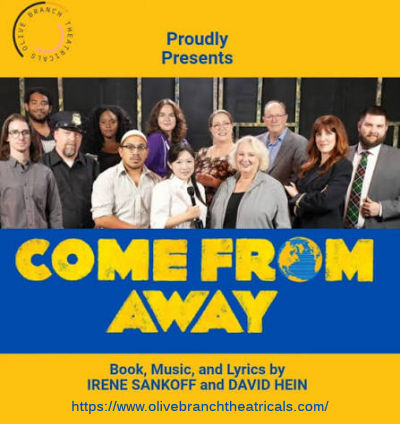
🎭 Best of Times, Worst of Times | “Come From Away” @ Olive Branch

userpic obt olive branchIt is strange to think of one of the worst times in America’s history as one of the best times. But, in many ways, it was. We saw the nation come together in ways we haven’t seen before, and in ways we really need again: for the nation, not for party. And we saw our neighbors and allies be there for America in our time of need, expressing friendship and helping people, without questions. In these times, where current American leadership is attacking our neighbors to the North and South (but, thankfully, not the real people), it is something we need again.

This is something that was going through my mind today as I saw the EXCELLENT production of Come From Away at Olive Branch Theatricals in Valencia (Santa Clarita). There are many productions of Come From Away in Southern California right now, including one that is well publicized over in Pasadena at A Noise Within (which starts tonight). You’re going to be seeing many many more in the days and months to come; for example, Chance Theatre is doing the show in January 2027.  But we specifically chose to see the show at Olive Branch, and reworked our schedule to fit it in. The reason is important.

Back in 2006, when I started getting back into heavy theatre attendance and writing up the shows I went to, one of our favorite small theatres was REP East in Santa Clarita. They did consistently great productions, but alas, they went away. In their space, another theatre opened, this time run by the City of Santa Clarita: The Main. The Main booked all sorts of shows into their tiny black box space, and helped (together with established venues like Canyon Theatre Guild) revitalize Main Street Newhall and the theatre scene in Santa Clarita. Out of their hard work, companies like Olive Branch Theatricals were formed: To do ambitious professional level theatre in Santa Clarita, and in doing so, upping the overall quality of theatre in the area. Alas, in August 2026, the entire block where The Main was located burned to the ground. We felt it was VITALLY important to keep supporting live theatre in our backyard, in Santa Clarita. So we specifically chose to see Olive Branch’s production of the show. It would also give us the opportunity to see the Olive Branch venue (they are located inside the Valencia mall), and to assess the overall quality of their work.

I’m pleased to say that our mission was a success. We came back VERY impressed. Olive Branch converted a former retail space (I’m guessing either Contempo Casuals or Charming Charlie) into a black box theatre on the dining / plaza level of the mall. There are under 99 seats, and the nature of the venue appears to allow flexible repurposing of the space. The major problem is that it isn’t a purpose-built space, so the seating isn’t raked. But the venue works well enough and the company has been very ambitious in the shows they are attempting, with a mix of larger musicals (they did Anastasia recently) to a mix of dramas. The quality of the performance was also very strong. The actors tend not to be AEA, but they have strong skills from film and TV in the area, as well as numerous other local intimate theatre productions. The upshot is: We’ll be back—they have a number of shows projected for 2027 that appear to be of interest. It also looks like they are providing a home to productions that lost theirs due to the fire; in particular, the production of Every Brilliant Thing we had hoped to see at The Main in September appears to have relocated to OBT the weekend of November 13.

But what did you think of the show, Mrs. Lincoln?

We first saw Come From Away at the Ahmanson Theatre in 2018. We saw it again at the Ahmanson in 2022. We love the show. We love the music. We love the message. We love the humor. It is one of those shows that uplifts you; that makes you realize the good that is in people if you just give them the chance. More on that in a minute.

Here’s what I wrote when I first saw this show back in 2018:

For those unfamiliar with the story behind Come From Away: It tells the story of the small town of Gander, Newfoundland. A small town of perhaps 7,000, it was at one time a major airport with the responsibility of fueling any trans-Atlantic flight. But by 2001, jets had rendered that function obsolete, and they had perhaps a half-dozen flights a day.

Then 9/11 happened. Then the US airspace was closed, and every flight destined for the US was diverted to the nearest airport. For 38 jets from across the world, that airport was YQX, Gander. With no notice, this small town saw its population double, and a need to accommodate, feed, and take care of passengers from these 38 planes for almost a week.

They stepped up. They did. They made friendships. They demonstrated the human spirit of caring and compassion. They didn’t asked to be paid, or for any compensation.

Come From Away is this story. Authors, composers, and lyricists Irene Sankoff and Devid Hein take the thousands of citizens of Gander, and the thousands of airplane passengers, and tell their story with just 12 actors. Under the direction of Christopher Ashley, it becomes a theatrical fugue or theatrical tapestry, weaving together different voices / threads that come together, when viewed at a distance and as a completed whole, that ultimately is captured in the refrain, “Welcome to the Rock”. It is that phrase, “welcome”, that is at the heart of this piece — and that welcome is successful because it is part and parcel with the notion of respecting the Come-from-aways because, ultimately, they are Islanders as well.

This year marked the 25th anniversary of 9/11. America, as a nation, is much more divided. Political leaders have exploited hatred—in particular hatred and fear of the other—to divide. Our political leaders have destroyed our relationship with our neighbor to the north, Canada. Where once they are friendly to the USA, the tariffs and posturing of the 47 administration have soured the relationship, to the point where Canada is much more independent, and turning much more towards the EU for their friendship. But the musical Come From Away reminds of the those better times, those better relationship. It reminds us that the people of Canada are good people, and we can have good relationships if we see them as people like us. Perhaps this administration needs to see more Come From Away, and less Evita and the Andrew Lloyd Webber canon.

Yesterday, I wrote about seeing The Outsiders at Broadway in Hollywood. This was a show filled with teen angsts, with drama, with violence, with anger, with societal clashes between classes, with death and fighting. It was a real downer, and I don’t really care to see it again. Come From Away, on the other hand, is uplifting. There is great music. There are uplifting people doing good without asking for something in return. There is love and friendship. In this divided era, this is what we need to see. Perhaps this is why so many companies are mounting Come From Away, and having great success with the show.

It doesn’t help that the musical is deceptively simple to put on (although I don’t know licensing costs). Twelve actors. A set that primarily consists of a large number of chairs. Lots of costumes, but none very elaborate. Your biggest expense is live music (if you go that route), having good choreograph, and a good dialect coach. If you cast strong actors and dancers, given the strong material, the show will be successful.

The Olive Branch production succeeded in most of those areas. The main one lacking was the use of live music: the lack of musician credits in the program makes me believe that OBT used recorded performance tracks from MTI. That’s not a surprise for a small company, but live music is always preferred.

The casting of the show was very strong. I could go on and say good things about every cast member: they were all that strong. In fact, I would, but I can find only so many superlatives in the thesaurus. I do want to highlight a few of the performances. Lauren Leland was outstanding as Capt. Beverly Bass and her other characters. She had a remarkably strong singing voice, but I also noticed the small mannerisms and facial expressions that brought her character to life. I also particularly liked Rachel Kellum’s Hannah and Tammie Pearson Richards’ Beaulah. They brought wonderful characterizations to the roles. Lastly, we always enjoy seeing Meggan Taylor on stage; we’ve know her for years and she brings a special something to her roles. On the male side, we enjoyed Ed Hill’s characterization of Nick, Castello Domingo’s characterization of Ali, Brandon McCravy’s Claude. We also enjoyed whoever played the rabbi. But, as I said, all of the performances were remarkable (especially when you consider that most of these folks don’t make their living as stage actors).

I also particularly noted the choreography. This is a tricky dance show, with a large number of dances that incorporate celtic dance steps as opposed to the traditional modern or ballet dance. The performance team executed them flawlessly, which is likely the result of a talented choreography team, led by Musette Caing Hart.

The direction team of Timothy Hart and Colin Sickafoose also did a good job. I often have trouble separating what the actor brings to a role from what the director brings. But in Come From Away, the director’s job is clear: They have to manage and work with all the actors to create multiple different characterizations from a single person. They have to create multiple distinct dialects from one individual, they succeeded. About the only weakness was that the firefighter’s mother, when adopted that persona, needed a stronger New Yawk accent (it came through near the end, but not as much during).

Were there any flaws? A few minor things. I found the moving lights at the top of the stage to be distracting at times, when they were aimed up and moving fast. The eyes tend to catch motion, and so that distracted. There were a few microphone glitches, in a venue that likely only needed amplification to be heard over the recorded instrumentation. That’s about it.

In short, this was an excellent production, and showed off Olive Branch Theatricals quite well. I’d encourage you to go see it, but the show we saw was the last one. So instead, I’m going to encourage you to do two things. First, go out to the Olive Branch Theatricals website and The Olive Branch website, and get tickets to other shows they will be doing. Second, determine what companies near you are doing Come From Away, and support them. Especially support the small companies that can really use your attendance. You might discover a company that you love.

Credits

Come From Away. Book, music, and lyrics by Irene Sankoff and David Hein. Directed by Timothy Hart & Colin Sickafoose. Choregraphed by Musette Caring Heart.

Cast: Michael Colon Bob, and others; Castello Domingo Kevin J, Ali, and others; Ed Hill Nick Marson, Doug, and others; Rachel Kellum Hannah, and others; Lauren Leland Annette, Captain Beverly Bass, and others; Brandon McCravy Claude, and others; Samantha Georgette Reed Bonnie Harris, and others; Tammie Pearson Richards Beulah Davis, and others; Ryan Stair Kevin T., and others; Meggan Taylor Diane Gray, and others; Jeremy Thompson Oz, and others; Yu Tsutsumi Janice Mosher, and others.

Music Department: Robby Good Music Director; August Eriksmoen Orchestrations; Ian Eisendrath Arrangements. Performance tracks likely provided by Music Theatre International (MTI), which provided all authorized performance materials.

Production and Creative: Timothy Hart and Colin Sickafoose Directors; Musette Caing Hart Choreography; Emily Pandise Props; Jeremy O’Brien Lighting Design; Chloe Koons Stage Manager; Natalie Arrendondo & Emily Holmen OBT Props; Jessica Morent, Ryan Sotdart, & Casey Padilla OBT Stage Managers and Crew; Colin Sickafoose OBT House Manager; Annette Sintia Duran OBT House Choreographer; Janet McAnany OBT Costume Director; Jeff McAnany OBT Marketing & Outreach; Jeremy O’Brien Facilities & Technical Direction.

Administrivia

I am not a professional critic. I’m a retired cybersecurity professional, a roadgeek who does a highway site and a podcast about California Highways, and someone who loves live performance. I buy all my own tickets, unless explicitly noted otherwise. I do these writeups to share my thoughts on shows with my friends and the community. I encourage you to go to your local theatres and support them (ideally, by purchasing full price tickets, if you can afford to do so). We currently subscribe or have memberships at: Center Theatre Group/Ahmanson Theatre; Broadway in Hollywood/Pantages Theatre; Pasadena Playhouse; The Soraya, Chromolume Theatre, and 5-Star Theatricals.

Want to find a show: Check out the Theatre Commons LA show list. Other good lists are the Theatre in LA listings; the TodayTix listings; OnStage 411 (use the “shows” drop down); and Theatermania. If you are looking for discount tickets, TodayTix (unlike their predecessor Goldstar Events) doesn’t handle the small theatres in LA. Luckily, Theatre Source LA has a new initiative: StageRushLA for discount tickets.

Sadly, we recently lost one of my favorite theatrical venues due to fire: the historical building housing Newhall Refinery, Care/Tucker Design, The Main, and El Troc was destroyed by a 3-alarm fire. Luckily, Canyon Theatre Guild next door was spared. I’ve been attending “The Main”, and it’s previous incarnation, Rep East Playhouse, since all the way back in 2006. Twenty years. Let’s pour a glass for the art and artists of Rep East/The Main, and hope that small and vital venues like The Main return to Santa Clarita soon. While you’re at it, contribute to support the artists of The Main who lost all their gear (they were in the middle of a show run). Do what you can to support theatre in Santa Clarita. I am: Our outing today for Come From Away is to the Olive Branch Theatricals production, in the Valencia Town Center. The leaders there got their start through REP and CTG.

Upcoming

Key: 🎭 Theatre / 🎼 Music / 🎙 Other Live Performance – Next 90ish Days (🎫 indicates ticketing is pending).

Share

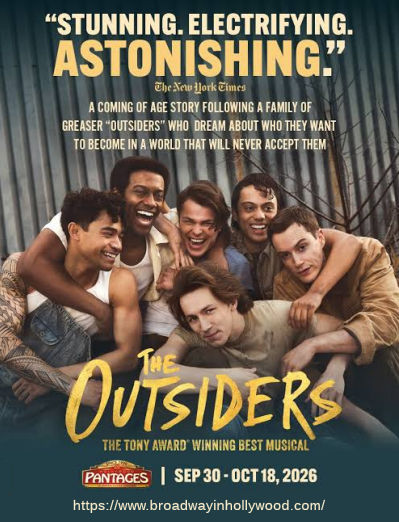
🎭 A Tulsa Story: 67 not 66 | “The Outsiders” @ BIH/Pantages

The Outsiders (BIH/Pantages)There are some shows you instantly love; the recent Water for Elephants is a great example of that. There are others that just never hit right, and you think about leaving; Girl From the North Country was one of those for us. The Outsiders, which we saw last night at Broadway in Hollywood/Hollywood Pantages, was—for us—a big “meh”.

I’m not saying that the show was bad, for it wasn’t. It won Best Musical, although I do think there were other shows in the season that were better. It drew an active and interested younger audience, which is great for the theatre. One could follow the story, which was dark and dramatic. It had loads and loads and loads of teen angst. The performances were very strong. There were a few catchy songs.

But it just wasn’t our thing. My wife left and sat in the lobby before intermission: the story was way to dark for her. I sat through the whole thing, but the story never drew me in. It’s not a musical I would care to see again: there are only a few catchy songs, and really one one (“Stay Gold”) that I think was a very strong song. This wasn’t a song and dance show. It was dark, with violence, death, sexual violence, domestic violence, gang violence, and borderline racism. There are ways to handle that: just look at Carousel. But this just didn’t grab me. Perhaps it would be different if I had seen the movie.

There’s a long detailed synopsis of the story on Wikipedia. I asked Gemini to summarize it. [Note that there are SPOILERS for Act II. I’ve tried to make Act II harder to read; highlight it if you want the spoilers]:

Act I introduces Ponyboy Curtis, a 14-year-old growing up in Tulsa, Oklahoma, in 1967. He navigates a fractured world divided by socioeconomic status, where his working-class gang, the Greasers, faces a violent rivalry with the wealthy Socs. After Ponyboy is attacked by the Socs, tensions steadily escalate. He and his best friend, Johnny Cade, meet a Soc girl named Cherry Valance at a drive-in, sparking mutual understanding but provoking a fierce confrontation with her drunk boyfriend, Bob. Later that evening, after a heated argument with his oldest brother and guardian, Darrel, Ponyboy runs away with Johnny. The two are cornered in a park by Bob and his gang, who attempt to drown Ponyboy in a fountain. To save his friend, Johnny stabs and kills Bob, forcing both boys to flee the city and hide in an abandoned church with the help of their hardened friend, Dally.

Act II follows the fallout of Bob’s death as the Socs declare an all-out war on the Greasers. While hiding out, Johnny decides he wants to return home and turn himself in, but tragedy strikes when the church catches fire. Johnny and Ponyboy bravely rush inside to save a group of children trapped inside, cementing themselves as local heroes. However, Johnny is severely injured by a falling beam, leaving him paralyzed in the hospital. Seeking retribution, the Greasers engage the Socs in a brutal rumble in the pouring rain and emerge victorious, but the triumph is short-lived as Johnny dies from his injuries shortly after. Driven mad by grief, Dally intentionally gets hit by a train and dies, leaving Ponyboy utterly distraught. Ultimately, Ponyboy finds a path forward after reading a heartfelt letter Johnny left behind. He reconciles with his brothers and begins writing down their collective story, which is revealed to be the opening lines of The Outsiders novel.

As you can see, a very dark story. Not your typical musical. Not our cup of tea. But I’m not saying it was bad; it just wasn’t something we would choose to see, or that we would particularly want to see again.

Before I go into the strengths of the show, I want to highlight one other problem—and this one isn’t show related, it is theatre related. For the first time that I can recall at the Pantages, there was tremendous bass music bleedthrough from the venue next to the Pantages (Audience Left, Stage Right). This bass—especially strong during the second, most dramatic act—was distracting and annoying. I’ve never had that happen before, and the Pantages staff needs to talk to the Frolic Room about the noise. Hopefully, it was a one-time thing.

That said, the staging was very strong. There were a number of things that struck me. First, the lighting design by Brian MacDevitt was very strong. It created the right mood, especially in the second act. I particularly noted the lighting during the fighting in the rain in the second act. Second, and again this relates to the fighting scene: The rain was very effective, and it is a difficulty and messy effect to have on the stage. Most shows avoid the problem by using projected rain. This was using real water, and when you combine that with the strange sand-like substance on the stage, it was really effective. Overall, the scenic design was interesting, with a dark junkyard feel and abandoned cars and tires. Very effective.

Performances were strong. At our performance, we had a swing understudy on for Ponyboy (Jordan Deandre Williams), and he was spectacular. Tyler Jordan Wesley was also very strong as Dallas, and Emma Hearn was great as Cherry Valance. A few other notables: Gabriel White Marín was strong as Bob, and Delaney Dias was a very strong dancer as Ace.

I’ve talked about the story and the performances. Turning to the music. Most of it was equally dark and, truthfully, didn’t catch my eye. I liked the opening and closing numbers, “Tulsa 1967”, as well as the gentle number “Stay Gold”. The rest, although they served the show, weren’t particularly memorable.

As you’ve probably figured out by now, this wasn’t the show for me. It wasn’t a bad show—it just wasn’t a show I liked. Our show today should be much better, as it is one of our favorites (Come From Away). But the real question is not us, but you. Should YOU see The Outsiders?

I think the answer is a definite maybe. If you are triggered by the subject matter of the show: domestic violence, suicide, sexual violence, racism—I’d avoid the show. If you don’t like really dark themes—avoid the show. Do not go in expecting a song and dance spectacular like Boop. This is much darker than the violence in Water for Elephants. It doesn’t have light numbers. It is definitely a PG-13 or R rated audience show for the themes.

If given all that doesn’t bother you, then go see the show. The performances are spectacular, and the staging is wonderful. Tickets are available through the Pantages website.

A last note for those reading this on my blog: I’m still working on the election analysis posts. Some of the work is easy for those offices still on the ballot from the Primary. But there are lots of Propositions at the state, city, and county level; there’s a whole new set of state-level judges, and there are LACCD trustees. Combine that with the upcoming show schedule, and I’d look for the ballot deep dive in 7-10 days, perhaps sooner. You can look for the Come From Away writeup sometime tomorrow, and perhaps a new podcast episode near the end of the week (if I get the editing done).

Credits

The Outsiders. Book by Adam Rapp and Justin Levine. Music and Lyrics by Jamestown Revival (Jonathan Clay & Zach Chance) and Justin Levine. Based on the novel by S. E. Hudson and the movie directed by Francis Ford Coppola. Directed by Danya Taylor. Choreography by Rick Kuperman & Jeff Kuperman.

Cast [underscores indicate “at our performance”; strikeouts indicate “not at our performance”; ↑ indicates “swung up”]:  Nolan White Jordan Deandre Williams Ponyboy Curtis; Bonale Fambrini Johnny Cade; Tyler Jordan Wesley Dallas Winston; Travis Roy Rogers Darrel Curtis; Corbin Drew Ross Jackson Reagin Sodapop Curtis; Emma Hearn Cherry Valance; Jaydon Nget Two-Bit; Gabriel White Marín Bob / Cop; Dante D’antonio Paul; Seth Ajani Guiseppe Little Ensemble; Christian Arredondo Tommy Kaiser Ensemble; Kevin Avila Brill, Ensemble; Delaney Diaz Ace; Gina Gagiano Ensemble; Will Hastreiter Brian Ho Pui Cheung Ensemble; Katie Riedel Marcia; Luke Sabracos Hayden Rivas Trip; Eli Talley Ensemble; Johnathan Tanner Tyson Hill Chet; Rodney Thompson Jr Steve; Alyssa Villareal Beverly; Swings: ↑ Brian Ho Pui Cheung, ↑ Tyson Hill, Hannah Jennens, ↑ Tommy Kaiser, ↑ Hayden Rivas Dance Captain; ↑ Jordan Deandre Williams, ↑ Guiseppe Little.

Music Department (🌴 indicates local): Justin Levine Music & Lyrics, Music Supervision, Arrangements, Orchestrations; Jamestown Revival Music & Lyrics; Matt Hinkley Music Supervision; Remy Kurs Music Director, Conductor; Adam Dorfman Assoc Conductor, Keyboard; Jackson Dunkin, Andrew Shield Guitars; Anthony Scandora Drums; Bella Amada Bass; Justin Brown Reeds; Anna Nordmoe Violin; E. Renée Gamez Asst Conductor, Keyboard Cover; 🌴 Ira Glansbeek Cello; 🌴 Jeff Driskill Tenor Sax, Bari Sax, Clarinet; 🌴 Michael Abraham Guitar 2 (Electric/Steel-String Acoustic); 🌴 Dan Lutz Bass (Acoustic/5-String Electric/Fretless); 🌴 Eric Heinly Orchestra Contractor; Kristy Norter Music Coordinator; Emily Grishman Music Copying; Alden Terry Music Preparation; Randy Cohen Keyboards Keyboard Programmer; Enrico de Trizio Ableton Programmer; Andrea Yohe Assoc Music Supervisor; Ed Benrock, Jamie Eblen, Mark G. Meadows, and Justin Smith Additional Arrangements.

Production and Creative: S. E. (Susie) Hinton Author; Adam Rapp Book; Justin Levine Book; Danya Taymor Director; Rick Kuperman & Jeff Kuperman Choreography; AMP featuring Tatiana Kahvegian Scenography; Sarafina Bush Costume Design; Brian Macdevitt Lighting Design; Cody Spencer Sound Design; Hana S. Kim Projection Design; Jeremy Chernick & Lillis Meeh Special Effects Design; Alberto “Albee” Alvarado Hair & Wig Design; Tishonna Ferguson Makeup Design; Taylor Bense Sound Effects Specialist; Jack Viertel Creative Consultant; Miranda Cornell Assoc & Resident Director; Autumn Angelettie Assoc Director; Kristen Carcone Assoc Choreographer; Nancy Renee Braun Choreography Supervisor; Gigi Buffington Speech Text & Dialect Coach; Beverly Jenkins Production Supervisor; Edmond O’Neal Production Stage Manager; Travis Blackwell Stage Manager; Julia Formanek Asst Stage Manager; The TRC Company Casting; Allied Global Marketing Tour Marketing & Press; The Road Company Tour Booking; Juniper Street Productions Production Management; 321 Theatrical Management General Manager.

Administrivia

I am not a professional critic. I’m a retired cybersecurity professional, a roadgeek who does a highway site and a podcast about California Highways, and someone who loves live performance. I buy all my own tickets, unless explicitly noted otherwise. I do these writeups to share my thoughts on shows with my friends and the community. I encourage you to go to your local theatres and support them (ideally, by purchasing full price tickets, if you can afford to do so). We currently subscribe or have memberships at: Center Theatre Group/Ahmanson Theatre; Broadway in Hollywood/Pantages Theatre; Pasadena Playhouse; The Soraya, Chromolume Theatre, and 5-Star Theatricals.

Want to find a show: Check out the Theatre Commons LA show list. Other good lists are the Theatre in LA listings; the TodayTix listings; OnStage 411 (use the “shows” drop down); and Theatermania. If you are looking for discount tickets, TodayTix (unlike their predecessor Goldstar Events) doesn’t handle the small theatres in LA. Luckily, Theatre Source LA has a new initiative: StageRushLA for discount tickets.

Sadly, we recently lost one of my favorite theatrical venues due to fire: the historical building housing Newhall Refinery, Care/Tucker Design, The Main, and El Troc was destroyed by a 3-alarm fire. Luckily, Canyon Theatre Guild next door was spared. I’ve been attending “The Main”, and it’s previous incarnation, Rep East Playhouse, since all the way back in 2006. Twenty years. Let’s pour a glass for the art and artists of Rep East/The Main, and hope that small and vital venues like The Main return to Santa Clarita soon. While you’re at it, contribute to support the artists of The Main who lost all their gear (they were in the middle of a show run). Do what you can to support theatre in Santa Clarita. I am: Our outing today for Come From Away is to the Olive Branch Theatricals production, in the Valencia Town Center. The leaders there got their start through REP and CTG.

Upcoming

Key: 🎭 Theatre / 🎼 Music / 🎙 Other Live Performance – Next 90ish Days (🎫 indicates ticketing is pending).

Share

🚘 Changes to the California Highways website: July – Sept 2026

Another quarterly cycle of updates to the website is complete. Here’s the changelog. Bottom Line: In addition to all the changes from headlines and various posts and emails, significant changes include: the addition of a load of new maps, including survey maps for Placer County; a link to a post with the history of Camp Hess Kramer; the passage of a lot of bills and resolutions at the end of the legislative cycle for the year; and loads of interesting actions from the CTC if you dig and read through them.

This update covers July, August, and September 2026. Before we dive into the updates to the California Highways site, an update on the California Highways: Route by Route podcast. As always, you can keep up with the show at the podcast’s forever home at https://www.caroutebyroute.org , the show’s page on Spotify for Podcasters, or you can subscribe through your favorite podcaster or via the RSS feeds (CARxR, Spotify for Podcasters). The following episodes have been posted since the last update on June 27, 2026:

  • July | CA RxR 4.13: Route 14: The Antelope Valley Freeway. Episode 4.13 continues our exploration of Route 14, picking up from the end of the first segment at I-5, and continuing to the junction with US 395 near Inyokern. As usual, along the way, we explore the history of the route, the conversion to freeway, major projects on the route, and naming along the route. This includes a detailed exploration of the start of the route in the Newhall Pass and Solemint area. It also includes an exploration of the “Aerospace Highway” name, and all the firsts that occurred at Edwards AFB and the test center next to the highway. Ep. 4.13 marks the end of the main episodes of Season 4, although we do have a couple of bonus episodes planned for the season break to tide you over. The first bonus episode, 4.14, covers New Idria Road and Hites Cove Road, which are mining roads in San Benito and Mariposa counties. (Spotify for Creators)
  • July | CA RxR 4.14: Bonus: New Idria Road and Hites Cove Road. Episode 4.14 is the first of two bonus episodes. It tells the story of the corridors of New Idria Road and Hites Cove Road. Both of these historic highway corridors lead to mining in Central California. This episode is based off blogs released on Gribblenation during October 2025 and May 2026. New Idria Road is an approximately 21.5-mile rural highway located in the Diablo Range of San Benito County. It branches off of Panoche Road, and winds its way south-ish through the Diablo range to the ghost mining town of Idria, continuing as Clear Creek Road. Hites Cove Road is an approximately seven-mile rural highway corridor located in the Sierra Nevada range of Mariposa County, south of Route 140, and west of El Portal. Hites Cove, and its successor forest and OHV trail roads, leads to the ghost town of Hites Cove on the south fork of the Merced River. Two interesting stories about two interesting ghost towns. Next up: Our second bonus episode to close out Season 4: A roundtable discussion with Adam Prince and Doug Kerr as we celebrate the 25th anniversary of the start of Gribblenation. (Spotify for Creators)
  • August | CA RxR 4.15: Bonus: 25 Years of Gribblenation. Episode 4.15 is the second of two bonus episodes. The year 2026 marks 25 years since Adam Prince, Doug Kerr, and Brian LeBlanc started the website. This episode features a discussion with Daniel, Tom (a Gribblenation contributor), Adam, and Doug about the past, present, and future of Gribblenation. Learn the story of how the site came to be, how the name was chosen, the hiccups along the way, and where the site is today. More importantly, learn the philosophy behind Gribblenation: To not only tell the facts and the history of the roads, but to tell the stories behind the roads. Next update: Coming sometime in late September 2026 will be Season 5 of the podcast, starting with the story of Route 15 and I-15 between San Diego and Temecula. (Spotify for Creators)
  • September | CA RxR 5.01: I-15 (Part 1): South of Temecula. Welcome to Season 5. We start the season with three episodes covering Route 15. The first (this episode), covers LRN 15, Sign Route 15, and today’s Route 15 between San Diego and Temecula. LRN 15 ran from what is now Route 1 near Fort Bragg to what is today’s I-80 near Emigrant Gap; it is today’s Route 20. Sign Route 15 is what became Route 7 and later I-710, and is today’s Long Beach Freeway. We have some interesting exploration of the ends of Sign Route 15 in Pasadena and Long Beach. We then turn to the main focus of the episode: Route 15, which runs from San Diego to the Nevada border, and has a complicated history. So complicated, in fact, that this episode focuses only on the portion between San Diego and Temecula, exploring both former Route 103 and US 395, as well as the transition from US 395 to today’s I-15 routing. Episode 5.02 will cover Temecula to Devore, and explore the history of I-15, I-15E, I-215, Route 71, US 91, US 395, and Route 194. Lastly, Episode 5.03 will cover Devore to Nevada, including I-15, US 395, US 66, US 91, and US 466 (with a bit of Route 195 and US 95 thrown in). (Spotify for Creators)

Turning to the updates to the California Highways pages: Updates were made to the following highways, based on my reading of the (virtual) papers and my research for the fifth season of the podcast in July, August, and September 2026 (which are posted to the roadgeeking category at the “Observations Along The Road” and to the California Highways Facebook group) as well as any backed up email changes. I also reviewed the the AAroads forum (Ꜳ). This resulted in changes on the following routes, with credit as indicated [my research(ℱ), contributions of information or leads (via direct mail or ꜲRoads) from Fred Akbar (FredAkbar)(2), Concrete Bob(3), Nathan Edgars (NE2)(4), Tom Fearer(5), Andy Field (andy3175)(6), Gonelookin(7),Adrian Ople(8), Mike Palmer(9), Plutonic Panda(10), Jim Rogers(11), Howard Schroeter(12), Tom Slater(13)]: Route 1(ℱ), Route 4(ℱ), I-5(ℱ), I-8(ℱ), Route 9(ℱ), I-10(ℱ,4,12), Route 12(ℱ,5), Route 14(ℱ), I-15(ℱ,6), Route 17(ℱ), Route 24(ℱ), Route 25(ℱ,5), Sign Route 26(ℱ), Route 26(ℱ), Route 29(ℱ), Route 34(ℱ), Route 36(11), Route 37(ℱ), Route 39(ℱ), Route 41(ℱ), Route 47(10), Route 49(ℱ), US 50(ℱ,9), Route 57(ℱ), Route 58(2,6,5), Route 64(ℱ), Former US 66(ℱ), Route 71(ℱ), Route 74(ℱ,6,10), Route 77(ℱ), I-80(ℱ), Route 84(ℱ), Route 85(ℱ), Route 86(ℱ), Route 88(5,7), Route 91(ℱ,6), Route 92(ℱ), Route 93(ℱ), Route 99(ℱ), US 101(ℱ,5), I-105(ℱ), Route 107(ℱ), Route 118(ℱ), Route 120(ℱ), Route 121(ℱ), Route 123(ℱ), Route 125(ℱ), Route 133(ℱ), Route 138(ℱ), Route 142(ℱ), Route 145(ℱ), Route 163(ℱ), Route 169(5), LRN 176(ℱ), Route 178(5), Route 180(5), Route 187(ℱ), I-215(4,12), Route 217(ℱ), Route 227(ℱ), Route 246(ℱ), Route 260(ℱ), Route 271(5), Route 299(ℱ), US 395(ℱ,5), I-405(ℱ), I-580(ℱ), I-605(ℱ), I-680(ℱ), I-710(9), I-880(ℱ), County Sign Route 66(ℱ), County Sign Route S26(8), County Sign Route S27(8), County Sign Route S28(8), County Sign Route S30(8), County Sign Route S32(8), De Anza Trail(9). Updated all the business route links, based on a post on AARoads. Added a link to the DeLeuw, Carther, & Company report, “Report on a Plan for Trafficways and Modifications to Railroad Operations and Facilities, Sacramento Metropolitan Area, Volume 1” to the Sacramento History Page(3).
(Source: private email through 10/1/2026, Highway headline posts through and including the September 2026 Headline post, AARoads through 10/1/2026)

Continued work on Season 5 of the Route by Route podcast. Research for and preparation of the episodes posted or written during this period resulted in changes and updates to the following routes: I-15, Route 16, Route 17, Route 18, Route 19, Route 30, Route 38, US 66, Route 71, Route 79, Sign Route 83, Route 85, US 91, US 95, Route 103, Route 130, Route 163, Route 164, Route 195, Route 206, I-210, Route 214, I-215, Route 238, Route 259, Route 262, I-280, Route 371, US 395, I-580, I-680, LRN 15, LRN 16, LRN 17, LRN 18, LRN 31, LRN 40, LRN 43, LRN 50, LRN 77, LRN 78, LRN 115, LRN 167, LRN 175, LRN 178, LRN 190, LRN 191, LRN 192, LRN 194, LRN 275, LRN 277, History of California Interstates.

Added some more GIS resources to the maps page. As a reminder: The California Highways Maps Page is often your best starting point for map-based research into California Highways. If readers are aware of any additional map-based resources I should add to that page, please let me know.

Updated Chargeable and Non-Chargeable Interstates and the Introduction to Interstate Highway Types pages to discuss the current funding formulas, and to clarify that the chargeable/non-chargeable distinction is more historic and less applicable today. Hat tip to Rothman on AARoads in this discussion for making me aware of the need to do another update pass on those pages.

Reviewed the online agenda of the California Coastal Commission for the July through September meetings. The following items were of interest:

  • September (Weds): Agenda Item 12.a. September 2026 Progress Report on the Caltrans Eureka-Arcata Hwy 101 Corridor Sea Level Rise Adaptation Plan. Informational update on Caltrans District 1’s progress on preparing a comprehensive adaptation plan for protecting, relocating, or otherwise adapting the Eureka-Arcata US 101 Corridor improvements authorized under CDP № 1-18-1078 to address anticipated sea level rise related flooding hazards.

Note that I also reviewed the CCC archives for information related to Camp Hess Kramer in Malibu. This was combined with other research, and led to a blog entry: “A Pre-History of Camp Hess Kramer“. This blog explores the history of camp property prior to the acquisition of the land by Wilshire Blvd Temple, including the history of Rindge Family ownership. I’m still looking for more information, particularly related to the history of the Yerba Buena School, the construction of Yerba Buena Road, and the construction of Decker Canyon Road (Route 23). The blog post also includes information on the future of Camp Hess Kramer and its sister camp, Gindling Hilltop Camp, as well as some records research. The post is also linked on the page for Route 1.

Reviewed the Pending Legislation page, based on the California Legislature site, for bills through 2026-10-01. As usual, I recommend to every Californian that they visit the legislative website regularly and see what their legis-critters are doing. As many people are unfamiliar with how the legislature operates (and why there are so many “non-substantive changes” and “gut and amend” bills), I’ve added the legislative calendar (updated for 2026) to the end of the Pending Legislation page. This is early in the even-numbered year session, so there’s a lot of introduction of placeholder bills, and a lot of amending of those placeholder bills (and bills that remained active from the previous year). Noted the passage of the following bills / resolutions (I also identified a number of errors in bills and resolutions, and submitted comments as indicated):

Read More …

Share