
 California Highways:
[Click here for a key to the symbols used. Some county routes were constructed with federal funds. These routes are indicated as FAP (Federal Aid Primary), FAU (Federal Aid Urban), or FAS (Federal Aid Secondary). If no funding source is shown, no federal funds were used. Note that while some segments seem to have the same attributes, they may differ in the county-local road number assigned to the segment, or in the Caltrans Map Sheet number.]
 Routing
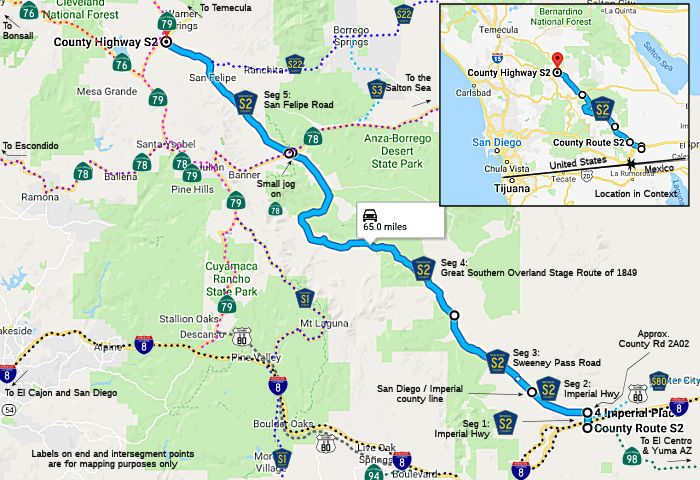 Imperial Highway from Route 98 to County Road 2A02 (FAS, 1.42 mi) [Imperial County]
Imperial Highway from County Road 2A02 to the San Diego county line (FAS, 7.40 mi) [Imperial County]
Sweeney Pass Road from the Imperial county line to the Great Southern Overland Stage Route of 1849 (FAS, 9.93 mi) [San Diego County]
Great Southern Overland Stage Route of 1849 from Sweeney Pass Road to Route 78 (FAS, 29.42 mi) [San Diego County]
San Felipe Road from Route 78 to Route 79 (FAS, 16.85 mi) [San Diego County]
 History and Signage Information
This route was defined in 1970. Supposedly, in the 1950s and 1960s, this was called a "Survival Route" out of San Diego.
 Naming
 In Ocotillo, US 80 meets Imperial Highway. The name "Imperial" refers to the
Imperial Valley, which took its name from the Imperial Land Co., a
subsidiary of the California Development Company charged with reclaiming
the water-starved but arable land east of San Diego for agricultural
purposes in the early 1900s. The company began building canals in 1900,
diverting water from the Colorado River for irrigation, and forming the
Salton Sea in the process. The Imperial Highway was an attempt by folks
from Los Angeles to patch together a superhighway that would stretch from
the Pacific all the way to Brawley in the Imperial Valley, a distance of
215 miles; the route was later extended a few miles farther south to El
Centro. Specifically, in 1912, a group of Los Angeles boosters informally
known as the Committee of One Hundred, working with Los Angeles, San
Bernardino, Orange, Riverside and Imperial counties, settled on a route
along the edge of the inland Salton Sea that completely bypassed San Diego
County, from which Imperial County had been split off in 1907. The road
would be mostly a straight shot from the coast of Los Angeles to Anaheim,
where the proposed road would dip south diagonally before eventually
reaching the Imperial Valley. By the 1920s, the efficacy of the Imperial
Highway concept had become apparent, and a new and more forceful private
group, the Imperial Highway Association, was formed in 1929 to encourage
the regions involved to mount a fully cooperative effort, including
working closely with San Diego County, to get the job done. This served to
add San Diego County routes to the mix. The route started from El Segundo,
went across Los Angeles and Orange County to Yorba Linda. It then went up
Santa Ana Canyon to Corona. From Corona, it ran SE down Temescal Canyon
through Lake Elsinore to Temecula, then along Route 79 and the old
Butterfield Stage overland route, established in 1858 (now County Sign Route S2) and down
to Ocotillo/Coyote Wells. An extension to Brawley was along Route 78 and
Route 86 The early Imperial Highway plans involved connecting a patchwork
assortment of roads of varying length and quality.
In Ocotillo, US 80 meets Imperial Highway. The name "Imperial" refers to the
Imperial Valley, which took its name from the Imperial Land Co., a
subsidiary of the California Development Company charged with reclaiming
the water-starved but arable land east of San Diego for agricultural
purposes in the early 1900s. The company began building canals in 1900,
diverting water from the Colorado River for irrigation, and forming the
Salton Sea in the process. The Imperial Highway was an attempt by folks
from Los Angeles to patch together a superhighway that would stretch from
the Pacific all the way to Brawley in the Imperial Valley, a distance of
215 miles; the route was later extended a few miles farther south to El
Centro. Specifically, in 1912, a group of Los Angeles boosters informally
known as the Committee of One Hundred, working with Los Angeles, San
Bernardino, Orange, Riverside and Imperial counties, settled on a route
along the edge of the inland Salton Sea that completely bypassed San Diego
County, from which Imperial County had been split off in 1907. The road
would be mostly a straight shot from the coast of Los Angeles to Anaheim,
where the proposed road would dip south diagonally before eventually
reaching the Imperial Valley. By the 1920s, the efficacy of the Imperial
Highway concept had become apparent, and a new and more forceful private
group, the Imperial Highway Association, was formed in 1929 to encourage
the regions involved to mount a fully cooperative effort, including
working closely with San Diego County, to get the job done. This served to
add San Diego County routes to the mix. The route started from El Segundo,
went across Los Angeles and Orange County to Yorba Linda. It then went up
Santa Ana Canyon to Corona. From Corona, it ran SE down Temescal Canyon
through Lake Elsinore to Temecula, then along Route 79 and the old
Butterfield Stage overland route, established in 1858 (now County Sign Route S2) and down
to Ocotillo/Coyote Wells. An extension to Brawley was along Route 78 and
Route 86 The early Imperial Highway plans involved connecting a patchwork
assortment of roads of varying length and quality.
In 1931, the association adopted an official route for a more streamlined, uniform highway running slightly west of the earlier Salton Sea route. The improved roadway, now referred to informally as “the Cannon Ball Road,” would eliminate tight right angle turns that slowed trucks, smooth and widen the various roadways involved, and have new bridges where necessary. By 1961, the final section of the Imperial Highway as envisioned by the association was completed, and it was dedicated a scenic highway in a ceremony on the Imperial-San Diego county border in December 1961. It is unclear whether the original Salton Sea routing included what is now County Sign Route S22 from Route 79 and County Sign Route S2 through Borrego Springs, or used the Route 78 routing.
In Ocotillo, the highway is still called Imperial Highway. As you follow it NW, it turns into Sweeney Pass Road, and then the Great Southern Overland Stage Route, San Diego County Sign Route S2. It passes through Agua Caliente Springs, meeting up with Route 78 E of Julian. It then continues as NW as San Felipe Road, still County Sign Route S2, to meet Route 79. From there, it follows Route 79 to Temecula, and through Temescal Canyon (former Route 71, now I-15) to Santa Ana Canyon, where it drops down present-day Route 91 to meet, surprise surprise, Imperial Highway in the Anaheim Hills. It then continues as Route 90 (which later was bypassed in portions by I-105), to the coast.
 National Trails
 This route is part of the De Anza National Historic Trail.
 Status
Total mileage: 65.02 mi.
© 1996-2024 Daniel P. Faigin.
Maintained by: Daniel P. Faigin
<webmaster@cahighways.org>.
 CR S1
CR S1 CR S3
CR S3