From Screen to Stage, in Blonde and Pink

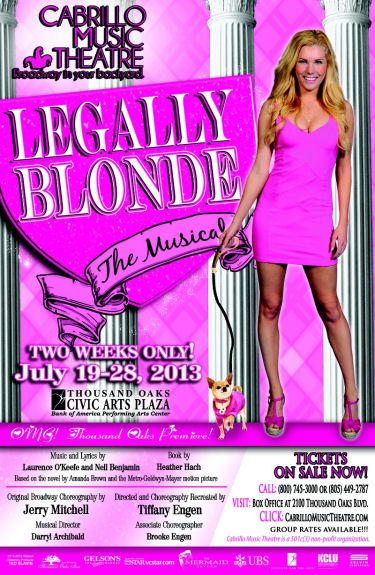
Legally Blonde - Cabrillo Music TheatreCabrillo UserpicMovie-to-stage adaptations are interesting beasts, especially when the target is a musical. The notion seems to be: take a familiar property, add music, stir well, and you end up with something entertaining for the audience. Sometimes the transition works spectacularly (“The Producers“), and sometimes it doesn’t (“King of Hearts“). Sometimes the transition is a serious rexploration and musicalization (“Man of No Importance“), sometimes it is a camp romp and parody(“Xanadu“), but most often it is somewhere in the middle. One such translation is the movie Legally Blonde” (2001), a fun summer flick about a blonde sorority girl chasing her man to law school, and discovering something about herself. The theatrical doppelganger to this confection appeared on Broadway in 2007: “Legally Blonde – The Musical“; it is currently on-stage in Thousand Oaks at Cabrillo Music Theatre (FB) in an excellent regional/professional production (non-tour). We saw it last night, and here are my thoughts on the show.

Legally Blonde – The Musical” (book by Heather Hach, music and lyrics by Laurence O’Keefe and Nell Benjamin), based on the novel by Amanda Brown and the motion picture) is a relatively faithful translation. It tells the story of Elle Woods, a UCLA Delta Nu sorority girl, about to be engaged to Warner Huntington III. When Warner dumps her for someone more serious to advance his law career, Elle makes the decision to follow him to Harvard Law School. She gets in, and initially her “blonde” ways get her rejected both by the other students and a key law professor, Callahan. But the teaching assistant Emmett Forrest, together with a mental greek chorus of her sorority sisters keep her positive. She decides to become a brunette, but the beautician Paulette, who convinces her to stay blonde and keep plugging away. After another setback when she embarrasses herself, Emmett helps Elle reassess her priorities until she realizes it is her obsession with Warner that keeps her from earning his respect. This helps her move forward legally, and win a coveted internship position. During this internship, Elle has to defined fitness queen, Brooke Wyndham, a former Delta Nu. Elle obtains Wyndham’s alibi where no one else could, but never discloses it. Instead, Elle and Emmett use smarts to break the case open. Calahan hits on Elle, and so Elle and Emmett go of on their own, are hired by Wyndham, and subsequently use fashion smarts to prove Wyndham’s innocence. Cue happy ending. [This is a summary – you can find a full synopsis on Wikipedia]

The translation to the stage makes a number of changes from the movie. Some are minor, and others are annoying and nonsensical. Emmett’s involvement is increased into a significant mentorship role (essentially incorporating the role of the female Law School president). This works. The end is also changed from Emmett and Elle dating to Elle proposing to Emmett, which also works well and shows an important change in Elle’s character. What doesn’t work are the changes to Paulette’s role, which is not only expanded in importance, but has a large Irish dance aspect added for no rational reason. These changes annoyed my wife, who is movie purist for this movie; for me, the only annoying change was the Irish stuff. Why, oh why, did they feel the need to add that?

Otherwise, I think this was a relatively successful adaptation — primarily because they played up the sillyness and humor to just the right amount. They lampooned sorority stereotypes and various behaviors without turning into camp, and without turning the production into a parody of the movie (“Silence!“). This, combined with the high energy production as the excellent direction by Tiffany Engen (FB), made this production a joy to watch.

I normally don’t talk much about the direction, for I have difficulty separating what the director brings to the production from what the actors bring to the production. The Cabrillo production was directed and choreographed by Tiffany Engen (FB), with choreography assistance by her sister, Brooke Engen (FB), based on the original Broadway choreography by Jerry Mitchell. These two blondes (the Engen girls, not Mitchell) brought a delightful manic energy and joy to the production — these actors were having fun with the moves, story, and performance, and that joy was transmitted to the audience, making this a fun show. There was a great mix of realism and fantasy, played well. I’m guessing this is the contribution of the director, but it wasn’t so heavy-handed that it wasn’t natural. In other words, so to speak, this was clearly a natural Blonde, not a bleached bottle Blonde that is trying too hard.

Helping this all work together was an excellent acting ensemble, led by Emma Egerstadt* (FB, FB Fan@DegerstedtEmma). Based solely on her look on the advertising postcards, I wasn’t sure she was right for the part. Then I saw her performance, and… wow! This young women was perfection as Elle — bubbly and determined, playful and sarcastic, and basically just a delight to watch. Hopefully, this is one of those Cabrillo finds that will go far in her career, and I hope to see her more on stage. Stealing the stage from Emma whenever he was on, however, was Frankie, the rescue dog playing Bruiser. Well-training and full of energy, this 7-year Chihuahua barked, jumped, and acted with abandon. Perhaps that’s why he was only on in selected scenes.

The second tier of actors were also excellent. Of particular note were Matt Bauer (FB, Muffookies) as Emmett, who portrayed a wonderful level of comfort and wisdom, as well as being an excellent actor, singer, and dancer. As Paulette, Lowe Taylor* (FB) was also very strong. We saw her back in 2011, in the Blank production of The Cradle Will Rock and we were impressed with her singing then; this show cemented the fact that she is a wonderful performer. Another notable performer was John D. Lemay (FB) as Callahan, who we’ve seen in numerous Cabrillo productions.  Lemay gave off a wonderful sharky-slime vibe, as well as being a great singer. Another supporting performer of particular note was Natalie Storrs (FB) as Vivienne. We were introduced to Storrs in Cabrillo’s You’re a Good Man Charlie Brown, where I wasn’t sure about Storrs’ look as Lucy, but was won over by her comic timing and singing skills. Both were put to great effect here, and she just was a delight as Vivienne (which was, inexplicably changed from the movie’s Vivian).  Lastly, Jaycie Dotin (FB) was wonderfully exhausting as Brooke, especially in her dance number that opened Act II.

However, in reality, all the supporting actors and ensemble was strong in their singing, dancing, and performance skills and it is difficult to highlight specific performances. Rounding out the cast were J. D. Driskill (FB, @jddriskill) (Warner); Sheila Karls (FB) (Enid); Veronica Dunne (FB?) (Margot); Kimberly Ann Moore/FB (Pilar); Caitlyn Calfas (FB) (Serena); Ben Bowen (FB) (UPS [Kyle] / Dewey); Ryan Braun (FB) (Aaron Shultz); Rachel Burkert/FB (Whitney / Delta Nu); Nathaniel Flatt (FB) (Nikos / Padamadon); Jay Gamboa/FB (Bailiff); Raquel Jeté (FB) (Judge / Delta Nu); Ashley Jones (FB) (Kate / Chutney); Kurt Kemper (FB) (Kiki); Natalie MacDonald/FB (Lellani / Stenographer / Cat Lady / Delta Nu); Sabrina Olivieri/FB (D.A. Joyce / Delta Nu); Jayson Puls/FB (DJ Chad / Ensemble); Tracy Ray Reynolds (FB) (Elle’s Mom); Kelly Roberts/FB (Elle’s Dad / Winthrop); Alex Sanchez/FB (D.A. Jack); and Lamont Whitaker (FB) (Carlos).

The musical side of the production was excellent.  Darryl Archibald (FB), who we last saw at Next to Normal, was musical director and conducted the wonderful Cabrillo orchestra. He was assisted by Kevin Roland (FB). The orchestra consisted of Darryl Archibald (FB) (Keyboard Synthesizer), Kevin Roland (FB) (Keyboard Synthesizer II), Alby Potts (FB) (Keyboard Synthesizer III), Sharon Cooper (Violin), Ian Dahlberg (FB) (Alto Sax, Oboe, English Horn, Flute, Clarinet, Piccolo), Gary Rautenberg (FB) (Baritone Sax, Clarinet Flute), Stan Hernacki (FB) (Trumpet I, Flugelhorn), Scott Wright (FB) (Trumpet II, Flugelhorn), David Blake (FB) (Tenor and Bass Trombone), Steve Bethers (Electric and Acoustic Guitar), Shane Harry (Double String and Electric Bass), Alan Peck (Set Drums), and Kelly Weaver (Percussion).

Technically, the show was a marvel. Under the technical Direction of Gary Wissmann, people and set pieces were flying everywhere but it was all working out great. The scenery was originally designed by John Patrick for Citrus College Music Theatre workshop, and worked very well. The costumes, designed by Carin Jacobs for FCLO Music Theatre in Fullerton, worked well (although the UCLA costumes weren’t UCLA). Wardrobe supervision was by Christine Gibson. Hair and Makeup was by Cassie Russek.  The lighting by  Christina L. Munich worked very well in establishing the mood and scene, and Jonathan Burke (FB)’s sound, as always, was clear and crisp. Animal Training was by William BerloniAllie Roy* (FB) was the production stage manager, and Kirsten D’agostaro Shook (FB) was the assistant stage manager. Cabrillo Music Theatre (FB) is under the artistic direction of Lewis Wilkenfeld (FB), who also introduced the show and introduced the stage crew just before Act II when he awarded a stage crew scholarship.

The last performance of “Legally Blonde – The Musical” at Cabrillo Music Theatre (FB) is today at 2pm. Tickets are available at the box office. Cabrillo has also announced their 2013-2014 season: Kiss Me Kate (October 18-27, 2013); Forever Plaid (January 31-February 9, 2014); In The Heights (March 28-April 6, 2014); and Bye Bye Birdie (July 18-27, 2014). Prices run from $229 for Orchestra to $100 for balcony, with special kids rates. Contact Cabrillo for more information.

Upcoming Theatre and Concerts:  This afternoon brings “Exposure” from OperaWorks at CSUN (FB). August starts with Nine at DOMA Theatre Ensemble (FB). That will be followed by “The Apple Tree” at ELATE/Lincoln Stegman]. Otherwise, August is currently completely open due to vacation planning, although we may see a show at the Lawrence Welk Resort in Escondido at the end of the month (depending on price), or at another venue in San Diego. September may bring Sarah Ruhl’s In The Next Room or The Vibrator Play at the Production Company/Secret Rose (FB) and “Blue Man Group” at the Hollywood Bowl. The middle of the month may bring “The Vagina Monologues” at REP East (FB), and the end definitely sees us back at REP East (FB) for “God of Carnage” (September 28). October 5th brings “Breath and Imagination” at the Colony Theatre (FB), as well as the Cabrillo Music Theatre (FB) production of “Kiss Me Kate” at the end of the month (October 26). November will start (hopefully) with “Dirty Rotten Scoundrels” at Actors Rep of Simi (FB), as well as ARTS’s Nottingham Village (FB) (a one-weekend ren-faire-ish market — tickets are now on sale). November will conclude with “Play It Again Sam” at REP East (FB) at the end of the month (November 23), and “Miracle on S. Division Street” at the Colony Theatre (FB).  The fall should also bring a production of “Carrie – The Musical (FB) by Transfer Theatre, but the specific dates have not been announced. As always, I’m keeping my eyes open as the various theatres start making their 2013/2014 season announcements. Lastly, what few dates we do have open may be filled by productions I see on Goldstar, LA Stage Tix, Plays411, or discussed in the various LA Stage Blogs I read (I particularly recommend Musicals in LA and LA Stage Times).

Share

The 1970s – When Men were Pigs, and Women Sang Country

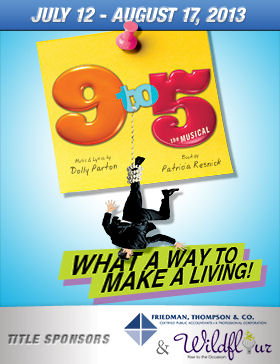
9 to 5 - The Musical (Rep East)userpic=repeastBack when I was in college, I saw a amusing movie starring Dolly Parton called “9 to 5“. Back in 2008, I saw “9 to 5” again — this time as a full-on, Broadway-bound musical at the Ahmanson. Five years later, I’m seeing “9 to 5” for a third time — this time in a creative production by our favorite under-81 seat playhouse in Newhall. The first had the story in the context of the time; the second had the razzle dazzle flash of Broadway; and the third stripped that back to show the musical for what it was. In this case, it showed it as a story bound in the 1970s, but with some powerhouse performances that overcame the story limitations.

One advantage of having seen the show before is that I don’t have to rewrite the synopsis — I can cut and paste. So, all together now, Control-C, Control-V:

For those unfamiliar with the movie, 9 to 5 tells the story of a mid-1970s office that produces, well, we’re never told quite what. There is the typical 1970s male chauvinist sexist pig boss, Franklin Hart (Dabney Coleman in the movie), who makes life a living hell for his buxom country assistant, Doralee Rhodes (played by Dolly Parton in the movie), his efficient head secretary Violet Newstead (Lily Tomlin in the movie), and the new hire, Judy Bernly (Jane Fonda in the movie). Fed up, one night they smoke pot and fantasize about how they would do him in. The next day, they almost mistakenly do it. While attempting to clean up the mess, they kidnap him and hold him prisoner in his house. They then take over running the company in his stead, improving efficiency… until he escapes. In the end, good defeats bad, and everyone gets what they deserve.

The musical version simply expands upon the bones created by the movie. This isn’t a surprise, as it features a book by Patricia Resnick, author of the original screenplay, and music and lyrics by Dolly Parton. The musical book hones very closely to the original screenplay, keeping almost all of the major movie incidents intact (including the fantasy sequences). It does provide some additional expansion on the home lives of Doralee, Judy, and Violet. The music includes the well-known theme song together with newer songs by Parton (which do have the distinctive Parton voice).

When we saw the show at the Ahmanson, it was on its way to Broadway. This meant, as I said above, that there was lots of razzle and dazzle. It was a technical marvel, with a full-size LCD backstage providing projection, multiple hydraulic elements moving major pieces up and down, numerous flying units (including Franklin Hart!), and loads of moving lights and scrims. That can’t be done in an 81-seat black box. What we got instead was creativity. The set featured a large turntable (I couldn’t tell if it was human or motor powered) that allowed alternation between the executive office set and the bedroom. There were a number of roll-able desk units that could be placed in front of this, together with couches and benches. The cast didn’t have a large backing ensemble. The costumes did a great job of reminding one of the 1970s, and at points were quite funny. This was particularly true in the aforementioned fantasy sequences, which featured a large number of Disney-esque costumes and quick costume changes. These forms of creativity are one thing I really enjoy about under-99 seat intimate theatre. It is why the recent Man of No Importance worked well, and why so many big Broadway flops work so much better at the intimate level. Razzle and dazzle does not a show make — it is performance.

Was the show perfect? No. There were a few things I found, for lack of a better word, “cheesy”. The first was the voice-overs by Dolly Parton at the beginning and end. I understand these were probably required by the licensing contract, but I hope in the future they can be replaced by an actor actually saying the lines (most likely, the actor playing Doralee). As it is now, the voice-overs bring it too much Dolly and do not let the show stand on its own. The other cheesy thing was the mustaches on a few of the actors.  They looked a bit like ’70s porn mustaches. Then again, this was a ’70s office. Maybe they were moonlighting 🙂 In any case, that’s not a major problem.

There were, however, four things that elevated this production to spectacular: the three lead actresses and the main supporting actress. The voices and performances of these three were spectacular, and not to be missed. My favorite was Sarah Krieg (FB) as Judy Bernly (the role originated by Jane Fonda in the movie and Stephanie J. Block on Broadway) . Unlike Jane and Stephanie, who were skinny mousey types, Sarah (who we recently saw as Rona in Spelling Bee) was a plus size powerhouse. This is a different look for Judy, but it worked quite well. Sarah has a remarkable singing and performance presence, which was powerfully shown during a number of numbers — in particular, “Get Out and Stay Out” and “The Dance of Death”. Equally strong was Erin Rivlin (FB) as Violet Newstead (the role originated by Lily Tomlin in the movie, and Allison Janney on Broadway). Erin also brought a different look to the role, but one that I liked. A powerful performer, Erin went beyond Janney to have a powerful singing voice as well (we’ve seen her do this at REP before, most recently in Trailer Park Musical). Erin was just delightful in “Potion Notion”, “Around Here”, and “Change It”. In the third lead position (which was more of a primary lead in the movie) was Gin Treadwell-Eng/FB as Doralee Rhodes (the role originated by Dolly Parton in the movie and Megan Hilty on Broadway). Gin moved the role away a bit from a Dolly-clone, as she couldn’t quite duplicate Dolly’s ummm, proportions. But Gin kept the country, and more importantly, had a strong country performance voice that made her performance a delight to watch. Spectacular numbers from Gin included “Shine Like the Sun”, “Cowgirls Revenge”, and “Backwoods Barbie”. Lastly, the surprising supporting performance came from Sarah Lang/FB. Knowing the character, one would think the performance was simply comic relief. But Sarah blew away the house with her performance in “Heart to Hart” — it was nerd-girl sexy and just… wow. From how the actress looked, you would never have expected that big voice to be in her.

The four women just discussed were the performances that grabbed and shook you. A number of other performance were also worthy of some specific mention. As Franklin Hart Jr., Billy Davis/FB gave a good portrayal of the lying, cheating, sexist, male pig. Also strong was K. C. Lindley/FB as Joe, the love interest for Violet. Lastly, as Margaret, Jane Arnett (FB) was so convincingly soused I was thinking we would need to call her a cab to get home; I didn’t want to see her tab at the Hydeaway Lounge! Rounding out the cast were Julie Berlin/FB (Kathy), Curtis Crawford/FB (Intern), Jim Crawford/FB (Dwayne), George D. Cummings/FB (Dick/Doctor/Tinsworthy), Liam Johnson (Josh), Donna Marie Sergi (FB) (Maria), Melissa Strauss (FB) (Missy), Beth Sweezer (Candy Striper), and Don Sweezer/FB (Bob Enright). I’ll also note that this was (a) one of the largest casts I’ve seen at REP in a while, and (b) there were a lot more CTG actors than we usually see at a REP show.

The production was directed by Leslie Berra/FB, a past Goldie award winner at CTG (which likely explains (b) above).  Leslie did a great job of making what is a massive production work in intimate quarters. She also, it appears, did it while keeping the fun in the show, for the actors seemed to be having a delightful time. She was assisted by Nancy Alterman (FB) as Choreographer, who came up with some very creative dance moves for the limited space.

At this point, I would normally credit the musicians. Alas, REP had to use pre-recorded music. I harbor a secret hope that one day REP can move to non-recorded musicians, but they just don’t have the space. Perhaps one day they can do a musical that has the musicians on the stage. Pump Boys and Dinettes? The Robber Bridgegroom? Golden Boy of the Blue Ridge? A Mulholland Christmas Carol?

Turning now to the technical. The clever and inventive set was designed by Jeff Hyde, Madi Orgill/FB (who also did the scenic design and paiting), and Mikee Schwinn/FB. Lighting was designed by the newly-married Tim Christianson/FB (Mazel Tov, Tim!). Sound was by Steven “Nanook” Burkholder/FB. The great costumes (especially in the fantasy sequences) were designed by Janet McAnany/FB. The resident stage manager is Christina Aguilar/FB. Amanda Grace Williams/FB was the production stage manager, assisted by Taylor Kozlowski/FB. As always, it is always fun to see the stage management and stage hands dancing in the hall just before the start of Act 2 :-). The show was produced by Mikee Schwinn/FB and Ovington Michael Owston/FB.

9 to 5 – The Musical” continues at Repertory East Playhouse through August 17th. Tickets are available through the REP Online Box Office or through Goldstar. The show is well worth seeing. REP has also announced two one-weekend shows: “Wake Up and Smell The Coffee” by Eric Bogosian on August 29-31, and The Vagina Monologues” by Eve Ensler on September 13-15.

REP has also provided a preliminary announcement of their 2014 season — their 10th anniversary. No dates as yet. The shows selected are: “I Love You, You’re Perfect, Now Change“, “Biloxi Blues” (Neil Simon), “Cat on a Hot Tin Roof“, “Return to Forbidden Planet“, “The Great Gatsby“, and “A  Few Good Men“.

Upcoming Theatre and Concerts:  Next weekend sees us back in Newhall for “9 to 5 – The Musical” at REP East (FB) on July 14. The following weekend is open for my wife’s birthday [ETA: I’ll be doing the So Cal Games Day on Saturday, and we’re going to the Renegrade Craft Faire for Karen’s Bday on Sunday] , and the The end of July brings “Legally Blonde – The Musical” at Cabrillo Music Theatre (FB) and (hopefully)  OperaWorks at CSUN (FB) on Sunday (now ticketed). August starts with Nine at DOMA Theatre Ensemble (FB). It may also bring “Why Do Fools Fall in Love?”  at the Santa Clarita Regional Theatre — this is a new Roger Bean show that sounds interesting [ETA: On the other hand, there is “The Apple Tree” at ELATE/Lincoln Stegman]. Otherwise, August is currently completely open due to vacation planning, although we may see a show at the Lawrence Welk Resort in Escondido at the end of the month (depending on price), or at another venue in San Diego. September may bring Sarah Ruhl’s In The Next Room or The Vibrator Play at the Production Company/Secret Rose (FB) and “Blue Man Group” at the Hollywood Bowl. The middle of the month may bring “The Vagina Monologues” at REP East (FB), and the end definitely sees us back at REP East (FB) for “God of Carnage” (September 28). October 5th brings “Breath and Imagination” at the Colony Theatre (FB), as well as October is mostly open, but should bring the Cabrillo Music Theatre (FB) production of “Kiss Me Kate” at the end of the month (October 26). November will start (hopefully) with “Dirty Rotten Scoundrels” at Actors Rep of Simi (FB), as well as ARTS’s Nottingham Village (FB) (a one-weekend ren-faire-ish market — tickets are now on sale). November will conclude with “Play It Again Sam” at REP East (FB) at the end of the month (November 23), and “Miracle on S. Division Street” at the Colony Theatre (FB).  The fall should also bring a production of “Carrie – The Musical (FB) by Transfer Theatre, but the specific dates have not been announced. We also still haven’t heard anything as to whether the Colony Theatre (FB) will have a 2013-2014 season. As always, I’m keeping my eyes open as the various theatres start making their 2013/2014 season announcements. Lastly, what few dates we do have open may be filled by productions I see on Goldstar, LA Stage Tix, Plays411, or discussed in the various LA Stage Blogs I read (I particularly recommend Musicals in LA and LA Stage Times).

Share

Life is Absurd

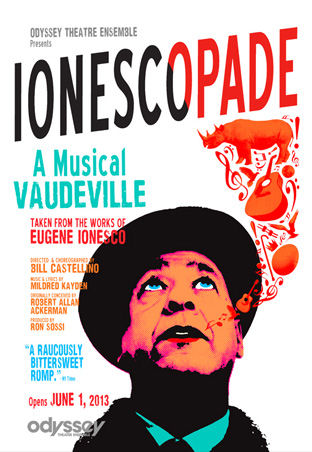
Ionescapade at the Odysseyuserpic=theatre_ticketsLife is absurd. You might as well accept the fact and enjoy the humor of life. This seems to be the point of the musical we saw last night at The Odyssey Theatre Group in West Los Angeles: “Ionescopade: A Musical Vaudeville“. Ionescopade is different than most musicals we have seen — there really is no through story (although there is a book); yet the disparate parts combine to give an overall through-line and message, if one is aware enough to see it. It is not for everyone; a number of audience members left during intermission. But for those who stick it out, you’ll have a thoroughly enjoyable evening — even if it is slightly strange. [Note: Musicals in LA posted an album on Facebook with images from the show. As it is public, throughout this post I’ll be linking to it. I encourage you to look at the images.]
Ionescopade is a musical that lives up to its subtitle: A Musical Vaudeville. The two-hour musical (with intermission) is a series of individual musical skits, connected only by a non-speaking character referred to only in the initial skit as “The Writer” (Alan Arlow). This character brings props and such on-stage and interacts with the remainder of the troup, yet remains apart from the rest of the actors. In a number of ways, “The Writer” is both a comic and an observer of the absurdity of the action (image).

All of the skits are drawn from the works of Eugene Ionesco, who is perhaps the father of absurdist theatre. Ionesco write a number of absurdist plays that are still produced, such as Rhinocerous. Ionesco dealt with the realities of facism, decay, corruption, and disgust for the tangible by retreating into the absurd. Perhaps this is best captured from the Rhinocerous quote in the program: “There are many sides to reality. Choose the one that’s best for you.” To construct Ionesopade, Robert Allan Ackerman (original concept) and Mildren Kayden (music and lyrics) drew upon Ionesco scenes, short plays, journal passages, conversations, and characters across all of Ionesco’s works. These were assembled into skits developed for a group of 6 actors and augmented with songs. Each skit is humourous in its absurdity, with points of laugh-out-loud funny and others of amazement. As you can guess, it is hard to describe.

Here are some examples. The Cooking Lesson (image) has Joey D’Auria and Alan Abelew  teaching how to cook a hard-boiled egg. There are lots of sight gags and simple sleight-of-hand magic, and the piece is simply enjoyable. The Leader has a number of characters worshipping their leader, and excited about seeing their leader. When the leader is finally seen, the leader is a puppet with no head. One character makes a remark along the lines that many popular leaders are headless. There’s a similar point being made about the absurdity of government in The Peace Conference (image) where the characters are simply arguing with each other without making any point at all.  Perhaps this is because they would rather talk at each other than listen. Sound familiar?

There’s also a chilling monologue in The Killer, where you wonder where the real insanity lies.

There are other skits that are just absurd, such as the one involving vaudeville Bobby Watson and family (all named Bobby Watson) (image), the one involving Mother Peep and her chicks, or the Wipe-out Games (where everyone seems to die).  There’s also a great musical number in Everyone is Like Me, where nothing is as it seems to be.

In short, the production is absurd. The director (who had a great interview in LA Stage Times) perhaps said it best: “watch it and don’t spend too much time trying to figure it out.  Just let it wash over you, concentrating on each object to the next.  Have a good time and think about it later.”

The madness of the production was under the firm directoral (and choreographical) hand of Bill Castellino, assisted directorially by Amanda Rountree/FB and choreographically by Camden Gonzales (FB). They somehow keep the craziness in check, make the characters seem realistic yet absurd, and provide great movement.

This is truly an ensemble piece, with only Alan Abelew* playing a single character throughout. All of the ensemble was great — let me highlight something about each member (I’ve already discussed Abelew). Andrew Abelson* (FB) gave a standout performance in The Killer and in the song Madeline. Joey D’Auria* (FB), a former Bozo-the-clown in Chicago was excellent throughout, but particularly so in Bobby Watson, The Cooking Lesson, in the song Josette, as one of the negotiators in The Peace Conference, and Frenzy for Two. Cristina Gerla (FB), whose performance just drew my eye to her throughout, was spectacular in Ginger Wildcat, Surprising People, and the Mother Peep number [I have this strong feeling that Gerla is either the daughter, or more likely grand-daughter, of my MS Thesis advisor at UCLA, Dr. Mario Gerla]. Kelly Lester* (FB) was great as the Prima Ballerina, Mother Peep, and numerous other roles. Tom Lowe (FB) was strong in Everyone Is Like Me and numerous other roles. Lastly, Jennifer Malenke* (FB) was strong as the Bald Soprano and in other roles.

The production was under the musical direction of Gerald Sternbach (FB), who also was wonderful at the piano. Assisting him on-stage were Hayan Charlston (FB) playing the reeds and Tina Curtis playing all sorts of percussion. They were just a hoot to listen to (and I really wish there was a recording of them doing this show).

Technically, the production was simple. The set by David Potts was simple: angled boxes and abstract clouds. This fit the absurdist nature of the piece. This was augmented by the wonderful props of Katherine S. Hunt (FB), which helped to bring the piece to light. Lighting was by Jeremy Pivnick (FB) and was both effective and creative. Similarly effective and creative were the costumes of Mylette Nora, especially in numbers such as Bobby Watson, Mother Peep, and … hell… the entire things was creatively costumed. The sound design was by Joe Behm/FB and Josie Griffin-Roosth (who also served as the stage manager). Ionescopade was produced by Ron Sossi (FB).

Ionescopade continues at the Odyssey Theatre Ensemble through August 11. It is well worth seeing. Tickets are available through the Odyssey Box Office or through Goldstar Events.

Upcoming Theatre and Concerts:  Next weekend sees us back in Newhall for “9 to 5 – The Musical” at REP East (FB) on July 14. The following weekend is open for my wife’s birthday, and the end of July brings “Legally Blonde – The Musical” at Cabrillo Music Theatre (FB) and (hopefully)  OperaWorks at CSUN (FB). August starts with Nine at DOMA Theatre Ensemble (FB), but otherwise is currently completely open due to vacation planning, although we may see a show at the Lawrence Welk Resort in Escondido at the end of the month (depending on price), or at another venue in San Diego. September may bring Sarah Ruhl’s In The Next Room or The Vibrator Play at the Production Company/Secret Rose (FB) and “Blue Man Group” at the Hollywood Bowl, as well as “God of Carnage” at REP East (FB) at the end of the month (September 28). October is mostly open, but should bring the Cabrillo Music Theatre (FB) production of “Kiss Me Kate” at the end of the month (October 26). November will start (hopefully) with “Dirty Rotten Scoundrels” at Actors Rep of Simi (FB), as well as ARTS’s Nottingham Village (FB) (a one-weekend ren-faire-ish market — tickets are now on sale). November will conclude with “Play It Again Sam” at REP East (FB) at the end of the month (November 23).  The fall should also bring a production of “Carrie – The Musical (FB) by Transfer Theatre, but the specific dates have not been announced. We also still haven’t heard anything as to whether the Colony Theatre (FB) will have a 2013-2014 season. As always, I’m keeping my eyes open as the various theatres start making their 2013/2014 season announcements. Lastly, what few dates we do have open may be filled by productions I see on Goldstar, LA Stage Tix, Plays411, or discussed in the various LA Stage Blogs I read (I particularly recommend Musicals in LA and LA Stage Times).

Share

You Just Have to Love Who (or What) You Love

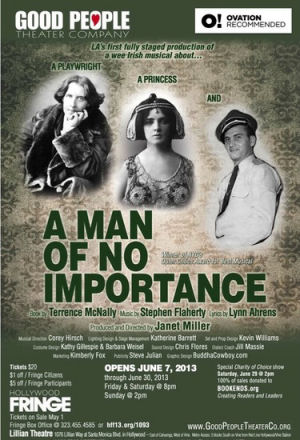
Man of No Importance (Good People at Lillian)userpic=theatre2I tend to be a completist. For theatre, this means I tend to acquire all cast albums of a particular composing team. In practice, this means that I often jump at the chance to see a show I’ve only heard. So when I discovered that the Good People Theatre Company was doing a production of Ahrens/Flaherty‘s A Man of No Importance as part of the Hollywood Fringe Festival, I immediately went out an bought tickets. Well, I bought them for the wrong date, but I quickly got that fixed :-).
A Man of No Importance is one of A/F’s less frequently produced pieces, perhaps because it doesn’t work well in the gigantic Broadway houses. With a book by Terrance McNally, and based on the 1994 movie with Albert Finney, it tells the story of Alfie Byrne in 1964 Dublin. Alfie is a conductor on a Dublin bus line; his only joy in life is producing and directing amateur theatre  in the basement of St. Imelda’s church. His favorite playwright is Oscar Wilde, and he has just finished producing yet-another mounting of Wilde’s The Importance of Being Earnest.  When a beautiful young woman joins his bus route’s regulars, he instantly decides on the troup’s next show: Wilde’s Salome. Alfie’s sister, Lily, is excited about this news, for she believe it means Alfie is finally interested in a girl and might get married (meaning she can marry the butcher, Lazer Wolf William Carney). But Alfie is interested in the girl, Adele Rice, only as his Salome; his unspoken affection is for his bus driver, Robbie Fay. Alfie is hesitant to act on his attraction, knowing what happened to Wilde (although Wilde, in his mind, keeps urging him on, noting that the only way to deal with temptation is to give in). So Alfie focuses on producing the play, with the support of most of his actors. However, his main male actor, Carney, feels the subject of the play is too immoral for the church to produce. He goes to the leader of the church, Father Kenny, and gets the production shut down. This drives Alfie out in the world where he acts on his impulses… with predictable results.  This brings his secret out (“the love that may not be spoken”) to the world. However, instead of rejection and bigotry from his friends and family, Alfie discovers… acceptance (from all but a few).

If the musical has a heart — and a heart I hadn’t realized before I had seen the production — it is the closing number of Act I: “Love Who You Love”. This number occurs when Alfie walks Adele home one night, and she tells him of the man she left behind in her home town. It goes as follows:

I’m not one to lecture
How could I dare
Someone like me who’s been mainly nowhere
But in my experience be as it may
You just have to love who you love

Your common sense tells ya best not begin
But your fool heart cannot help plungin in
And nothing and no one can stand in your way
You just have to love who you love

People can be hard sometimes
And their words can cut so deep
Choose the one you choose, love
and don’t lose a moment’s sleep
Who can tell you who to want
Who can tell you what you were destined to be
Take it from me

There’s no fault in lovin
No call for shame
Everyone’s heart does exactly the same
And once ya believe that, you’ll learn how to say
I love who I love who I love
So just go and love who ya love

Such a beautiful song.

As for this production, under the directoral hand of Janet Miller (FB)… well it was just remarkable. I always find it wonderful when a production that wasn’t really right for the “big Broadway stage” works in a small venue. I’ve seen this in a number of shows: Kiss of the Spider Woman, The Story of My Life, The Wedding Singer, and many others. A Man of No Importance is one of those shows. Miller’s direction, a fine acting ensemble, and the correct under-99-seat venue combine to produce a gem of a show — one that touches and moves you (even in the wilting heat of a Southern California summer). Miller utilizes the limitations of the venue to great effect — there are no major set pieces — she establishes the scene through a collection of chairs, a bookcase, a table, and a few props. The performances she draws out are enough to mesmorize and transport you to 1964 Dublin without major fly-ins or backdrops. Just wonderful. As for the acting ensemble…

In the lead position, playing Alfie Byrne, is Dominic McChesney (FB). McChesney is perfect in the role: mild, expressive, and yet… powerful. He has a delightful singing voice, and does something I love to see in actors: he inhabits the role. By that I mean that when you watch the performance, you forget you are watching an actor — you believe you are seeing the character portrayed. When this happens, it is just great.

Supporting McChesney is a wonderful team of actors that seem to be having so much fun with their characters, it is infectuous. I’ll name some of my favorites first, and then list the rest. Playing both Carney and Oscar Wilde is David Gilchrist (FB). We’ve seen Gilchrist in a number of productions at Actors Rep of Simi and at Cabrillo, but he gave one of his best performances here. He was so expressive, and so much in character, that it was just a joy to watch him. I also enjoyed watching Marci Richmond Herrera (FB) as Miss Crowe. I don’t know what it was, but there was just something that drew my eye to her whenever she was on stage. As Adele Rice, Audrey Curd (FB) (G+) brought an inner beauty and strength to her performance that served her well when the reason was revealed at the end. Also particularly notable were the performances of Shirley Anne Hatton (FB) as Lily Byrne, Matt Stevens (FB) as Baldy O’Shea, and Keith Barletta (FB) as Robby Fay. Hatton’s Lily was wonderful in her duet “Books” with Gilchrist’s Carney, and Stevens was equally strong in his number “The Cuddles Mary Gave”. Barletta was just strong overall. Rounding out the excellent ensemble were Mary Chesterman (FB) (Mrs. Grace/Kitty Farrelly); Gail Matthius (Mrs. Curtin); Corky Loupé (FB) (Rasher Flynn/Carson); Michael P. Wallot (FB) (Ernie Lally); Melina Kalomas (Mrs. Patrick); Bret Shefter (G+) (Sully O’Hara); Matt Franta (FB) (Peter/Breton Beret); and Terrence Evans (Father Kenny).

The music in this production was excellent. Under the musical direction of Corey Hirsch (FB), the musicians from the Los Angeles Musicians Collective provided a great Irish band,  with a fiddle, flute, keyboard, guitar, and what looked like a mandolin, plus various boxes for percussion. They were just a delight to listen to. The Pantages should hire these folks when Once comes to town!

Turning to the technical and “behind the scenes” folk: The set and properties design by Kevin Williams was simple but effective, as I noted above. This befitted the fringe nature of the production, but also worked well to entice the audience to use their imagination to set the scene — something that movies cannot do. This was supported by the costume designs of Kathy Gillespie (FB) and her sister, Barbara Weisel (FB), (both formerly with the Costume House in Irvine) , whose wonderful costumes transported the audience to 1964 Dublin. Also effective was Katherine Barrett (FB)’s lighting design — both in the spots, but particularly in the backwash along the brick wall. The sound design by Chris A. Flores was what a sound design should be — unobtrusive and invisible, and you could hear the actors clearly. Dialect coaching was by Jill Massie and (to my ear) was quite good — it sounded convincingly Irish without being so heavy as to obscure the dialogue (which was, for example, a problem with both Billy Elliott and Priscilla at the Pantages). Katherine Barrett (FB) was the stage manager, assisted by Rebecca Schroeder (FB). I’m not listing all the publicity folks.

The last performance of A Man of No Importance is, alas, today at 2pm. As that’s less than two hours away as I write this, that means you can only get tickets at the door of the Lilian Theatre at 1076 Santa Monica Blvd (unless they are sold out). I’m looking forward to future productions from Good People Theatre (FB), especially if they are doing musicals not commonly done.

Upcoming Theatre and Concerts:  July starts with a musical we had originally planned for Fathers Day weekend: Ionescapade” at the Odyssey Theatre Ensemble. That will be followed by “9 to 5 – The Musical” at REP East on July 14, and “Legally Blonde – The Musical” at Cabrillo at the end of the month. July will also (hopefully) see us as OperaWorks at CSUN. August is currently completely open due to vacation planning, although we may see a show at the Lawrence Welk Resort in Escondido at the end of the month (depending on price), or at another venue in San Diego.

Continuing the look ahead: September may bring Sarah Ruhl’s In The Next Room or The Vibrator Play at the Production Company/Secret Rose and “Blue Man Group” at the Hollywood Bowl, as well as “God of Carnage” at REP East. October is open, but should the Cabrillo production of “Kiss Me Kate” somewhere, as well as “Dirty Rotten Scoundrels” at Actors Rep of Simi. November will bring “Play It Again Sam” at REP East as well as ARTS’s Nottingham Village (a one-weekend ren-faire-ish market). The fall should also bring a production of “Carrie – The Musical” by Transfer Theatre. As always, I’m keeping my eyes open as the various theatres start making their 2013/2014 season announcements. Lastly, what few dates we do have open may be filled by productions I see on Goldstar, LA Stage Tix, Plays411, or discussed in the various LA Stage Blogs I read (I particularly recommend Musicals in LA and LA Stage Times).

Share

Another Problematic Woman

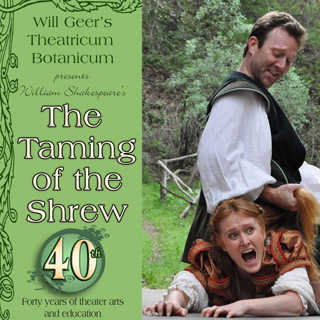
Taming of the Shrew (Theatricum Botanicum)userpic=yorickEarlier today, I wrote of a theatre piece that focused on a woman with a behavior problem: she was bipolar, and couldn’t let go of her grief. But women with problems have been the focus of theatre for ages. This afternoon I saw a much older theatre piece about another problematic women: “The Taming of the Shrew” by William Shakespeare. As is common with Shakespeare pieces during the summer, it was at an outdoor venue: Will Geer’s Theatricum Botanticum in Topanga Canyon.

First, a word about the venue. My wife had been to Botanicum back in the 1970s, shortly after it was founded by Will Geer and his wife, during the days he was on The Waltons. Botanicum is in a wooded canyon; the theatres are in little amphitheatres with outdoor stages and bench seating. Actors are anywhere and everywhere  — this is very much outdoor theatre of the 1970s, not the enclosed structures of today or the little black boxes. In many ways, this is theatre as it was meant to be: actors honing their craft, using their skill and not technology to tell a story. Batanicum is also very much a repertory company: the cast of actors are doing multiple plays concurrently over the summer — Shrew is just one of them. They are also doing Midsummers Night Dream, The Royal Family, Merlin, and Tone Clusters. It is a joy to watch, and we’ll likely be back for future productions.

Now, on to the show itself. If you are not familiar with Shrew, all I can say is go watch the “Atomic Shakespeare” episode of Moonlighting. You know — Bruce Willis, Cybil Shepard. Oh, right, you’re too young. Go rent Kiss Me Kate. As for me, the last time that I saw Shrew on stage was back in 2008 when it was part of Santa Clarita’s Shakespeare in the Park. I do love me a good production of Shrew, and this one was a fun one.

This production of Shrew established the mood early, with a madrigal group singing outside the line to the theatre. However, there was this annoying drunk wandering around trying to cage cadge a ticket and get someone to save him a seat. Somehow he succeeded, because as we came into the theatre, so did he. In fact, during the pre-show announcements he waltzed on stage and the house manager had to call security, but before they arrived, he collapsed on the steps. Just then, some hunters showed up (speaking the Bard’s good English), and decided to pull a trick on him. They would dress him as a king, and perform a comedy for him. And thus… the framing of The Taming of the Shrew.

As with much of Shakespeare, distinguishing all of the different characters is difficult (especially when there were some last minute substitutions). I’ll list them all in a minute. First, however, I’d like to highlight some particularly strong performances. In the lead positions were Willow Geer (FB) as Katharina and Aaron Hendry (FB) as Petruchio. You can see them pictured in the image above. These two leads were perfectly matched to each other. Hendry was athletic and charming, well built, and just fun to watch. Geer was a tiger-cat — able to pull out her claws and purr on demand. These two were just having fun with the role, and just a delight whenever they were on the stage.

Also strong, but not quite as stand-out-ish, were Christine Breihan (FB) as Bianca. She was charming, but didn’t seem to acquire a personality to the end. Also strong was the drunk, Christopher Sly (Gerald C. Rivers (FB)), who was doing a great job of fooling theatre patrons before the show, and was a delight to watch while he remained in character throughout the production.

As for the remainder — it was truly an ensemble. All were wonderful, but no particular actor stood out over another. Here’s a full listing of the rest of the cast, but some roles were substituted at our production: Liz Eldridge (FB) (Widow/Musician), Bill Gunther (Gremio), Charles M. Howell IV (FB) (Pedant); Christopher W. Jones (FB) (Hortensio); Leo Knudson (Joseph/Priest), Gabrielle Lamb/FB (Servant/Player), John Maidman/FB (Ludentio), Melora Marshall (FB) (Grumio), Timothy McCray/FB (Curtis), Marcelo Olivas (FB) (Biondello), Kila Packett (FB) (First Huntsman/Baartholomew), Chynna Skye Pozzessere (FB) (Third Huntsman), Franc Ross (Baptista), Taylor Jackson Ross (FB) (Stage Manager/Haberdasher), Evan Tamayo (FB) (Philip), Esdras Toussaint (Nathaniel), Paul Turbiak (FB) (Lord/Vincentio), Frank Weidner/FB (Tailor/Musician), Christopher Weir (FB) (Second Huntsman), Jeff Weisen (FB) (Tranio). Understudies were Jonathan Blandino/FB, Jessica Butenshon, Kevin M. Connolly, and Dane Oliver/FB.

The production was directed by Ellen Geer, who did a wonderful job of bringing out the fun in the production — these actors were having the time of their lives, and it showed. Stage management was by Kim Cameron/FB assisted by Brandi Martin. The costumes, which were very inventive, were designed by Val Miller/FB. Properties were mastered by Shen Heckel. Sound was by Ian Flanders, who likely coordinated the on-stage musicians that provided the sound effects. Lighting was by Zach Moore/FB, although our production had mostly natural light.

Taming of the Shrew continues in Repertory through September 29. It is well worth seeing. Tickets are available online; you might also be able to find them on Goldstar.

Upcoming Theatre and Concerts:  The last weekend of June brings a Maria Muldaur concert at McCabes, as well as Man of No Importance (Hollywood Fringe) at the Lillian.   July starts with a musical we had originally planned for Fathers Day weekend: Ionescapade” at the Odyssey Theatre Ensemble. That will be followed by “9 to 5 – The Musical” at REP East in the middle of the month, and “Legally Blonde – The Musical” at Cabrillo at the end of the month. July will also (hopefully) see us as OperaWorks at CSUN. August is currently completely open due to vacation planning, although we may see a show at the Lawrence Welk Resort in Escondido at the end of the month (depending on price), or at another venue in San Diego.

Continuing the look ahead: September may bring Sarah Ruhl’s In The Next Room or The Vibrator Play at the Production Company/Secret Rose and “Blue Man Group” at the Hollywood Bowl, as well as “God of Carnage” at REP East. October is open, but should the Cabrillo production of “Kiss Me Kate” somewhere, as well as “Dirty Rotten Soundrels” at Actors Rep of Simi. November will bring “Play It Again Sam” at REP East as well as ARTS’s Nottingham Village (a one-weekend ren-faire-ish market). The fall should also bring a production of “Carrie – The Musical” by Transfer Theatre. As always, I’m keeping my eyes open as the various theatres start making their 2013/2014 season announcements. Lastly, what few dates we do have open may be filled by productions I see on Goldstar, LA Stage Tix, Plays411, or discussed in the various LA Stage Blogs I read (I particularly recommend Musicals in LA and LA Stage Times).

Share

The Definition of Insanity

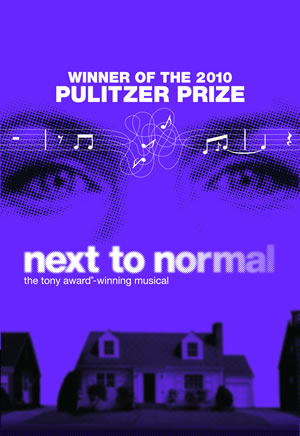
Next to Normal (La Mirada)Some say that the definition of “insanity” is doing the same thing and expecting different results (others say that that the DSM is wrong and we’re only diagnosing based on symptoms, but that’s later in this post). So, then, are theatre goers insane — we often go and see the same show over and over. Are we expecting different results, or are we just expecting to see the same show?  What do we expect to see in the different versions?
I can’t answer for everyone, but for me, I see different productions of the same show to find nuances, to see particular actors, and to see how different venues approach the material (especially different sized venues). I’m bringing this all up because last night I went to see a musical about mental illness; a musical that I last saw only a few years ago at the end of 2010. The musical is “Next to Normal” (music by Tom Kitt; book and lyrics by Brian Yorkey), and I decided to see it again because (a) I like the show, but more importantly (b) our experiences with the director and a number of cast members led me to conclude that this would be an excellent production. I wasn’t wrong — it wasn’t insanity to see “Next to Normal” again; rather, it was an experience that was well worth the drive (it was out in La Mirada, where we last saw Johnny Guitar in 2006) and provided additional insights.

As I’ve seen the show (and written up the show before), I’ll just repeat the synopsis I wrote up the last time. The story didn’t change from then:

Next to Normal” tells the story of a dysfunctional family: the mother (Diana) who is falling deeper and deeper into the depths of her mental illness (bipolar); the father (Dan) who is attempting to hold it all together; the daughter Natalie who has been lost in the shuffle, and the son, Gabriel, who is the lynchpin for Diana’s illness. It is the story about how holding on to something too tightly can be just as damaging as not holding it enough… or at all. It is the story of how treating mental illness is not an exact science; although doctors offer a range of treatments from pharmacology to talk therapy to hypnosis to even stronger therapies, it is just throwing spaghetti on the wall. It is the story of Natalie and Henry, and how being in the middle of dysfunction and mental illness can affect a teen relationship… and how one can use substances to attempt to run away from problems, but it doesn’t help. Ultimately, it is the story of family, and that things don’t always work out how you expect them, but hopefully they work out for the best.

Next to Normal” is such a great musical due to its honest treatment of mental illness. We see there is no cut-and-dried treatment. In “Next to Normal”, the triggering event for Diana is the death of her son at 8 months. She never lets go of the grief; rather, she embraces it and truly keeps her son alive in her mind, to the detriment of everything else. Although initially she could apparently cope (and even had another child shortly after), she began to lose it as her daughter got older. This impacted her daughter, for her mother never drew close to her. Diana’s husband, Dan, reacted in the other direction: he detached from his son, wanting to hide the memories away in a box, and live focused on the present. The latter (as the musical implies) is equally unhealthy, but is more acceptable to society. It also showed the differences in thinking for many men, who make a commitment to be there for the ones we love; good or bad, we hold things together.

(returning to the present) Every time I see this show, I see echoes of my life. I had a brother who died when I was ten; my mother went into a deep depression shortly thereafter that (I believed) colored her life thereafter and ultimately led to behaviors that killed her. Valium was indeed her favorite color. My wife has dealt with depression (successfully), and I’ve seen her mother deal with the inability to let go of grief. As I said the last time I saw this show: “The musical hits home for those that live with depression: the inability to get anything done and how that affects the family. It hits home with those who live with the manic side as well: the up-at-all-hours unpredictability that is equally taxing. This hits home—it is a deeply personal, touching musical.”

I also said last time — and I still agree — that Next to Normal is one of the best examples of a musical that needs the stage. Movies tend to be focused in the real (even if that is an alternative reality). What we see on the screen is realistic. Musicals allow the emotions to come out and be expressed, and Next to Normal is all about emotions. If you can find a production of this near you, it is well worth seeing.

As I wrote in the beginning, the primary reason I wanted to see this particular production was the director and the cast. I wasn’t disappointed. The director for this show was Nick Degruccio (FB), who has done numerous musicals in the Southern California area … all of which have been great. This show was no exception. Nick brought out the raw emotion from the actors, and connected with the audience (I know it brought out the emotion and me, and I heard others audience members saying something similar). If you have the opportunity to see something Nick directs, do it. The odds are good it will be excellent.

The casting for this production was spot on. Back in 2010, I saw the tour with the original Diana, Alice Ripley, in the lead. This production cast Bets Malone (FB) in the lead.  We’ve seen Bets in numerous productions at Cabrillo and throughout Los Angeles, and she is consistently one of the best musical performers in Southern California. She didn’t disappoint here — in fact, I think her performance was stronger than Ripley’s because she somehow made the performance and the character seem real and down-to-earth.

Also attracting us to the production was Tessa Grady as Natalie, Diana’s daughter. Tessa is another actor we see regularly in roles — we’ve seen her at the Colony and Cabrillo, and have always been impressed with her. She was very strong here, and gave a wonderful performance (I’m running out of superlatives) as the daughter.

Diana’s husband, Dan, was also played by Southern California regular, Robert J. Townsend (FB). We saw Townsend in the great production of The Story of My Life at Havok, and in numerous Cabrillo productions. Yet again — wonderful voice, wonderful performances.

Rounding out that cast — again, all with spectacular performances — were Alex Mendoza/FB as Henry, Eddie Egan (FB) as Gabe, and Keith A. Bearden (FB) as Dr. Madden. We’ve seen Mendoza before (Justin Love, Cabrillo) and Bearden (Johnny Guitar), but Egan was new to us. All were strong and a delight to watch.

Musically, the production was very strong, with musical direction by Darryl Archibald (FB) (another Cabrillo alumni). Archibald also conducted the 6 piece band, which included Archibald on piano, Dave Lofti on Percussion, Joe Jewell (FB) on Guitars, Shane Harry on Electric Bass and Acoustic Bass, Claudia Vanderschraaf/FB on Cello, and Tyler Emerson/FB on the odd combination of Violin and Keyboard.

The technical production was also excellent. The scenic design by John Ezell was reminiscent of the set at the Ahmanson, although lacking the eyes. I particularly noted how at points the background was cracked and imperfect. The lighting by Steven Young was also strong and effective, doing a wonderful job of creating the mood. The sound design by Josh Bessom provided clear and crisp sound (better than the production at the Ahmanson, where the orchestra overpowered at times), although there were a few static problems with the mics. The costumes by Kish Finnegan worked well with the characters, and the properties by Terry Hanrahan were effective. The prop/costume package were from the Arizona Theatre Company. David Cruise was the Technical Director. Jill Gold was the production stage manager, assisted by Phil Gold. The executive producers were McCoy Rigby Entertainment.

The last performance of Next to Normal is today, June 23. 2013. You can buy tickets online here.

Upcoming Theatre and Concerts:   Today brings more theatre: “The Taming of the Shrew” at Will Geer’s Theatricum Botanicum. The last weekend of June brings a Maria Muldaur concert at McCabes, as well as Man of No Importance (Hollywood Fringe) at the Lillian.   July starts with a musical we had originally planned for Fathers Day weekend: Ionescapade” at the Odyssey Theatre Ensemble. That will be followed by “9 to 5 – The Musical” at REP East in the middle of the month, and “Legally Blonde – The Musical” at Cabrillo at the end of the month. July will also (hopefully) see us as OperaWorks at CSUN. August is currently completely open due to vacation planning, although we may see a show at the Lawrence Welk Resort in Escondido at the end of the month (depending on price), or at another venue in San Diego.

Continuing the look ahead: September may bring Sarah Ruhl’s In The Next Room or The Vibrator Play at the Production Company/Secret Rose and “Blue Man Group” at the Hollywood Bowl, as well as “God of Carnage” at REP East. October is open, but should the Cabrillo production of “Kiss Me Kate” somewhere, as well as “Dirty Rotten Soundrels” at Actors Rep of Simi. November will bring “Play It Again Sam” at REP East as well as ARTS’s Nottingham Village (a one-weekend ren-faire-ish market). The fall should also bring a production of “Carrie – The Musical” by Transfer Theatre. As always, I’m keeping my eyes open as the various theatres start making their 2013/2014 season announcements. Lastly, what few dates we do have open may be filled by productions I see on Goldstar, LA Stage Tix, Plays411, or discussed in the various LA Stage Blogs I read (I particularly recommend Musicals in LA and LA Stage Times).

Share

The Million Dollar Bus

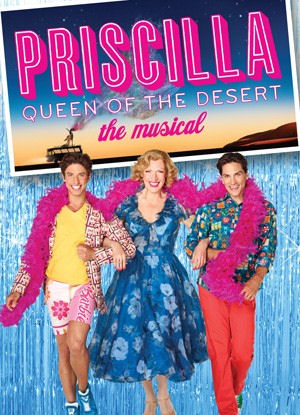
Priscilla - Queen of the Desert (Pantages)userpic=broadwaylaIf you were to ask me a week ago, I probably would have thought this review would be comparing the flash and glam story of Priscilla – Queen of the Desert (which we saw last night at the Pantages) with the deep and serious story at the heart of Scottsboro Boys. Although that comparison is still apt, the real parallel for Priscilla is  Elton John’s Million Dollar Piano which we saw in early May. The stars in Elton’s show were the music and the million dollar piano; in Priscilla, it is the music and the million dollar bus.
If you are not familiar with the story, Priscilla – Queen of the Desert is a musical version of the 1994 movie. The surface story is a slight one: three Australian drag queens leave Sidney to travel across the Australian desert in an old bus to Alice Springs, where they have been hired to work in a casino. Along the way, they hit a number of small Australian towns, which don’t know what to make of the three drag queens — and so they get to win them over with the dual powers of drag and disco music. The slightly deeper story concerns the road trip of each of the three main queens: Tick/Mitzi (the leader) instigates the trip at the behest of his wife (Marion), who wants him to go to Alice Springs to meet his son, Benji. Bernadette just lost the man of her dreams in Sidney, and is questing to find the right person. Adam/Bernadette is questing to, as he put it, to climb a rock in a frock with a cock. Along the way they pick up a mechanic, Bob; wear fabulous outfits; travel in a beat of RV that they transform into Priscilla; and dance numerous popular numbers.

As I indicated earlier, I initially thought I would be contrasting the serious story at the heart of Scottsboro Boys to the fluff that is Priscilla. But that’s not the best comparison. Priscilla is really a musical version of The Million Dollar Piano. First and foremost, the star is Priscilla, a bus that is covered with an LED lighting system that, once it is activated, provides visual imagery just like the piano did in Elton’s show. It is also a show that doesn’t focus on new music, but delights in bringing back the favorites that please the audience. Lastly, and most importantly I believe, is that Tick’s journey mirrors that of Elton John. He starts out a performer who is best known for his flash and outrageous costumes, and goes on a journey that bring him to fatherhood and family. It is a similar journey that is the real heart of Priscilla: Tick’s journey from being a drag performer in Sidney to being (albeit still a drag performer) a father with a son in Alice Springs. This transformation — this heart — is what turns this from a campy jukebox musical into a touching theatre piece.

Just like drag queens… and much of Elton’s act… the focus is on flash. The show opens with three diva being lowered from the ceiling belting out disco tunes. These diva return throughout the evening to set the stage with appropriate disco music. There are costumes and sequins and dresses and heels galore (and not just on the ladies, but the men as well, and even on Priscilla (the bus)). There is even audience participation (as some audience members go on stage for a hoedown) and a dancer who pops corks into the audience (seemingly) from her vagina (something I never thought would be on the stage of the Pantages). This is all played with a sense of fun and joy; the goal is to make the evening a party — a faaaaaabulous celebration. This is not an issue of getting the drag queens to accept who they are; the acceptance here is that of the world, who is going to accept the drag queens for what they are. This played well with the Los Angeles audience, and especially with a group of gays who were sitting near us and having the time of their life with this show.  It also plays well with the end of the show, and the question of whether Tick’s son will address Tick as who he is — a very non-traditional father. Perhaps this is the ultimate theme of Priscilla — have fun with life, embrace who you are, find and embrace your family (however it is constituted), and look fabulous along the way.

The story of Priscilla was adapted for the stage by Stephan Elliott, the author of the original screenplay, and Allan Scott. The transformation was relatively faithful to the film, from what I hear. It was brought to life under the directorial hand of Simon Philips (assisted by Associate Director David Hyslop) with choreography by Ross Coleman (assisted by Joshua Buscher, Associate Choreographer, and Andrew Hallsworth, the original Assistant Choreographer). This transformation worked relatively well — you believed that these were real people as much as you could (c’mon, an LED encrusted bus in the middle of the Australian desert requires a large amount of suspension of belief). I think the real effect of the direction was to bring out the inner queen in all of the performers; to encourage them to go up a notch or two (or three or four) in bringing out their inner fabulousity and beauty. The dancing and movement was then added to amp things up even more to bring unbridled joy to the show. Priscilla is a show you walk out of feeling good. It makes you happy; it lifts your mood on 8″ pumps.

The performances in Priscilla were spectacular. The leads in particular turn the performance from what could have been a stereotypical drag queen performance into something much deeper (similar to the way we see the depths of the characters in To Wong Foo, Thanks for Everything…). As Tick, Wade McCollum moves along a path from Diva to Father. At the beginning, Tick is a man unsure about embracing the fact he is a father (from a marriage dating to before his transformation) to a man who accepts it as part of who he is. McCollum portrays this wonderfully, along the way singing and dancing up a storm. Scott Willis, as Bernadette, undergoes a similar transformation. Starting out as an old-style lip-synching drag queen who has just buried her boyfriend, Bernadette goes on this journey to find something new… and along the way, finds something she didn’t expect in a place she didn’t expect. Willis’s Bernadette was a remarkable performance, reminding me a lot of Lauren Bacall in Woman of the Year — tall, statuesque, and strong, with surprising singing and dancing chops. Lastly, Bryan West‘s Adam/Felicia is the most impulsive of the three, living the drag life for all the fun she can squeeze out of it. The real motivation of her character never comes out (a story flaw), and at the end you are left wondering if she is the same girl that started on the trip. Still, West’s performance was spectacular and a joy to watch.

In the second tier, we have performers who were less out there singing and dancing as their characters, and more for the non-singing characters they portray. This includes Joe Hart as Bob, the mechanic who joins  Priscilla midway and discovers a new life (but not in drag). Hart’s performance is realistic and fun to watch. I’m also impressed that Hart admits, in his bio, that he was in the original casts of both Bonnie & Clyde and The Best Little Whorehouse Goes Public. It also includes the characters that bookend the story: Christy Faber as Marion and Will B. / Shane Davis as Benji (not sure which performer we had). These are the wife and son that instigate and ground Tick’s journey. These three characters together provide the normalcy of the piece — they are realistic people that you would like to meet (and note that these really aren’t singing roles). This “grounding” is what makes the entire drag side acceptable; these three show that the drag queens are real people under the glam. In particular, the portrayal by these three actors just makes this all real.

Rounding out the cast is a large ensemble of singers and dancers, including the aforementioned three divas. They do not particularly establish characters that stick with you, although they are remarkable dancers, singers, and are a hoot to watch. These performers are Emily Afton (Diva, Ensemble), Bre Jackson (Diva, Ensemble), Brit West (Diva, Ensemble), Taurean Everett (Jimmy, Ensemble), Nik Alexzander (Miss Understanding, Ensemble), Chelsea Zeno (Cynthia, Ensemble), David Koch (Frank, Ensemble), Travis Taber (Farrah / Young Bernadette, Ensemble), Babs Rubenstein (Shirley, Ensemble), John Capes (Ensemble), Andrew Chappelle (Ensemble), Alex Deleo (Ensemble), Amy Hillner Larsen (Swing), Chris Klink (Ensemble), Ralph Meitzler (Swing), and Alex Ringler (Ensemble). Of these, the most memorable were the divas, singing wonderfully and moving the best they could on their hanging platforms, and Babs Rubenstein, who for some reason kept drawing my eye with her comic performances.

Musically, the show is a delight. This is a jukebox show, with songs primarily drawn from the disco era: “It’s Raining Men”, “What’s Love Got to Do With It”, “Go West”, “I Love the Nightlife”, “Colour My World”, “Girls Just Wanna Have Fun”, “Boogie Wonderland”… you get the idea. The actors and dancers had fun with the music, and so did the audience. Orchestrations were by Stephen “Spud” Murphy and Charlie Hull. Murphy was also the overall music supervisor, with Jeff Marder having that responsibility in North America.  Brent Frederick was music director, and Talitha Fehr of TL Music International serving as music coordinator. Frederick also conducted the 11 person orchestra.

Technically, a lot of credit goes to Brian Thompson, the scenic designer. He created the bus that is Priscilla; he created the remarkable sets and transformations that are on stage (and that make this a production that may never be done on a high-school stage). A few words about Priscilla: this is a bus that can rotate to show all sides, with turning wheels, covered in LEDs. It is quite amazing. Also setting the scene was the wonderful lighting of Nick Schlieper and Jonathan Spencer — the lighting designed by these two not only establishes the mood, but becomes part of the music through the movement and the images on Priscilla. The third part of the scene setting was done by the wonderful costumes of Tim Chappel and Lizzy Gardiner. These were spectacular and creative, especially in the “Shake Your Groove Thing” number, and the imaginative approach to costumes in Alice Springs. I also loved the interaction between the costumes, the lighting, and Priscilla in “MacArthur Park”. Technical supervision was by MB Productions. You may have noticed I’ve saved sound design for last — that’s because the sound design (by Jonathan Deans and Peter Fitzgerald) was the most problematic. On one hand, the show had great sound effects and there were no micing problems. On the other hand… this is the Pantages. Sound — especially accents — is very muddied when you are sitting in the back of the theatre. Either the lead sound designers — or more likely, the Pantages master sound engineer Shane Cook, did not retune to the sound design for the Pantages’ peculiar acoustic signature. We had to strain to hear and understand that actors. That shouldn’t happen.

Lastly, Tom Bartlett was the production stage manager, Chad Lewis was the stage manager, Ryan J. Bell was the assistant stage manager, and Roberta Roberts was the general stage manager.

Priscilla – Queen of the Desert continues through June 16 at the Pantages. Tickets are available from the Pantages online, although they are cheaper in person at the box office. You can also get them through Goldstar. If you want to have a fun couple of hours, Priscilla is worth seeing.

The Pantages has announced their 2013-2014 season (which starts after Sister Act (7/09 – 7/28/13)), and (for me) it is mostly “ehhh”. It consists of the following shows (shows I’m planning to see are in bold): Andrew Lloyd Webber’s production of The Wizard of Oz (9/17-10/06/13); War Horse (10/08-10/13/13);  Evita (10/23-11/10/13); Disney’s The Lion King (11/20/13-1/12/14); The Book of Mormon (1/21/14-2/09/14); Green Day’s American Idiot (5/13-5/18/13); The Music of Andrew Lloyd Webber (6/03-6/22/2014); Ghost – The Musical (6/27-7/13/14); Once – A New Musical (7/15-8/10/14).

Dining Notes: Once again we opted to take the Red Line from North Hollywood to the Pantages at Hollywood/Vine. I recommend this as it saves on parking hassles and $$. It also allowed us to discover a great Puerto Rican restaurant in North Hollywood: Mofongos Comida Caribeña. This is on Lankershim between Oxnard and Burbank (a few blocks from the No. Hollywood Red Line station) and was just wonderful. We’ll be back.

Upcoming Theatre and Concerts:   Next weekend, so far, has no theatre: Saturday will be So Cal Games Day 54, and Sunday (Fathers Day) will likely be a trip to the ScienceCenter and the newly renovated Museum of Natural History. The third weekend of June brings Next to Normal” at La Mirada, with Nick DeGruccio directing and starring Bets Malone and Tessa Grady. The last weekend of June brings a Maria Muldaur concert at McCabes, as well as Man of No Importance (Hollywood Fringe) at the Lillian.   July starts with a musical we had originally planned for Fathers Day weekend: Ionescapade” at the Odyssey Theatre Ensemble. That will be followed by “9 to 5 – The Musical” at REP East in the middle of the month, and “Legally Blonde – The Musical” at Cabrillo at the end of the month. July will also (hopefully) see us as OperaWorks at CSUN. August is currently completely open due to vacation planning, although we may see a show at the Lawrence Welk Resort in Escondido at the end of the month (depending on price), or at another venue in San Diego.

Continuing the look ahead: September may bring Sarah Ruhl’s In The Next Room or The Vibrator Play at the Production Company/Secret Rose and “Blue Man Group” at the Hollywood Bowl, as well as “God of Carnage” at REP East. October is open, but should the Cabrillo production of “Kiss Me Kate” somewhere, as well as “Dirty Rotten Soundrels” at Actors Rep of Simi. November will bring “Play It Again Sam” at REP East as well as ARTS’s Nottingham Village (a one-weekend ren-faire-ish market). The fall should also bring a production of “Carrie – The Musical” by Transfer Theatre. As always, I’m keeping my eyes open as the various theatres start making their 2013/2014 season announcements. Lastly, what few dates we do have open may be filled by productions I see on Goldstar, LA Stage Tix, Plays411, or discussed in the various LA Stage Blogs I read (I particularly recommend Musicals in LA and LA Stage Times).

Music: I Do Not Want What I Haven’t Got (Sinéad O’Connor): “The Last Day Of Our Acquaintance”

Share

The Truth May Not Set You Free, But It Can Inspire

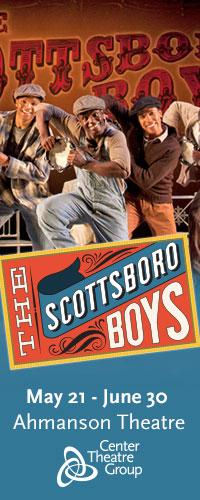
Scottsboro Boys (Ahmanson)userpic=ahmansonThis weekend has been an interesting juxtaposition of theatre with two productions that echo the same theme, but tell the story in different ways and make different points. Saturday night we were in Newhall seeing REP’s production of “To Kill a Mockingbird; last night we were in DTLA seeing CTG’s production of the Kander-Ebb musical, “The Scottsboro Boys. Both tell the story of black men accused of raping white women in the south in the early 1930s. Both involve trials where the innocence of the black men becomes clear. Both involve a jury going with its prejudices instead of with the truth. Both end up with tragic ends for the defendants, with ultimately important larger realizations. If you can afford to do so, I strongly recommend you see both in close proximity — you’ll find it very moving.  Further, if you can find a production of Jason Robert Brown’s Parade to add to the mix, I strongly suggest you do so. The melding of the three themes will be mind-altering.

Yesterday, I related the story of To Kill a Mockingbird. That story deals with the loss of innocence and the perversion of justice, but does so in a comfortable manner. It uses a traditional courtroom setting and the curiousity of children to bring home its point. Although the point is strong, it is accessible. Scottsboro Boys, on the other hand, is “in your face” uncomfortable from the opening, primarily due to how the authors and composers chose to present the story. More on that in a minute.

Scottsboro Boys tells the story of the Scottsboro 9. The Scottsboro Boys were nine black teenage boys accused of rape in Alabama in 1931. The case included a frameup, an all-white jury, rushed trials, an attempted lynching, an angry mob, and is an example of an overall miscarriage of justice. The short version is this: On March 25, 1931, several people were hoboing on a freight train traveling between Chattanooga and Memphis, Tennessee. Several white boys jumped off the train and reported to the sheriff they had been attacked by a group of black boys. The sheriff deputized a posse, stopped and searched the train. He arrested the black boys, and found two white girls who accused the boys of rape. The case was first heard in Scottsboro, Alabama in three rushed trials, where the defendants received poor legal representation. All but the thirteen-year-old Roy Wright were convicted of rape and sentenced to death, the common sentence in Alabama at the time for black men convicted of raping white women. But with help from the American Communist Party, the case was appealed. The Alabama Supreme Court affirmed seven of the eight convictions, and granted thirteen-year-old Eugene Williams a new trial because he was a juvenile. Chief Justice John C. Anderson dissented however, ruling that the defendants had been denied an impartial jury, fair trial, fair sentencing, and effective counsel. The case was returned to the lower court and the judge allowed a change of venue, moving the retrials to Decatur, Alabama. During the retrials, one of the alleged victims admitted fabricating the rape story and asserted that none of the Scottsboro Boys touched either of the white women. The jury found the defendants guilty, but the judge set aside the verdict and granted a new trial. After a new series of trials, the verdict was the same: guilty. The cases were ultimately tried three times. For the third time a jury—now with one black member—returned a third guilty verdict. Charges were finally dropped for four of the nine defendants. Sentences for the rest ranged from 75 years to death. All but two served prison sentences. One was shot in prison by a guard. Two escaped, were charged with crimes, and were sent back to prison.

John Kander and Fred Ebb (composer and lyricist), together with David Thompson (book), chose to tell this story in a novel fashion. Eschewing the traditional musical style, they chose to tell the story as a minstrel show. This was a style of variety show that has disappeared, and was known for lampooning black people and accentuating stereotypes. As such, the style of the show makes the audience intentionally uncomfortable. It has been said by some that this style is one reason this show died on Broadway; I would tend to agree, and I think this show is (like Chicago before it) intentionally ahead of its time. Despite all of our professed acceptance of racial tolerance, our society is not yet tolerant (as illustrated by the reception of our first black president). Until there is true and deep racial acceptance in society, I don’t think audiences will be comfortable with this show.

In any case, this story is told in the style of a minstrel show. This means that there is a elderly interlocutor who runs the show, two fools (Mr. Bones and Mr. Tambo) who buffoonishly provide comic relief, and the rest of the performers (in this case, the nine Scottsboro boys). Through a series of acts, these actors tell the story of the Scottsboro Boys from their initial arrest through the various trials. Repeatedly, the boys emphasize that they want to tell the truth this time — to have the true story come out — and that telling the truth is unlike what had happened before. Lastly, observing this all is an unnamed middle-aged black woman … more on this later.

When the show starts, the boys obligingly do what the interlocutor wants, without question — even if it foolish. As time goes on the insistence to stick with the truth grows and grows. By the time the musical ends, the boys are defiant. No longer subservient to the white interlocutor, they insist on doing things on their terms and sticking with the truth. This mirrors how blacks have grown in society, insisting on their civil rights … insisting on the truth. It is in understanding this that the role of the unnamed women becomes significant.(slight spoiler here) … for the last scene reveals that the women is Rosa Parks, and the courage of the boys insistence to do what is right is one of the inspirations for her not to go to the back of the bus.

As I indicated, this is a musical that makes one uncomfortable. It holds up — to a bright light — the racial stereotypes that were common in the south in the 1930s. It not only makes fun of those stereotypes, it also highlights the antisemitism that was common as well in the South. This is why earlier I mentioned that seeing this musical in the context of JRB’s Parade is so important — Parade tells the story of the Leo Frank trial and subsequent lynching — another travesty of justice where a man was killed because he was Jewish.

Scottsboro Boys is an important musical, but it is not easy to watch. In this, it is much like Caberet or Kiss of the Spider Woman — it attempts to present an uncomfortable subject in a way that calls for discussion afterwards. In doing so, this is theatre at its best — something that challenges and exposes. This isn’t the feel-good musical that leaves you humming (think Oklahoma, Hello Dolly, Hairspray, or Wicked). This is a musical — like South Pacific, Carousel, or Parade — that leaves you thinking about the uncomfortable side of human nature. The truth is sometimes uncomfortable. To put it another way… as we walked out of this show, we found ourselves quoting Urinetown: “But the music, its so pretty.This line referred to the fact that Urinetown had pretty music, but an uncomfortable subject matter and title. Similarly, Scottsboro Boys has pretty music… but the subject and the point it makes is pretty uncomfortable.

Turning from the subject to the performance, which were spectacular. Framing the Scottsboro Boys minstrel show were Hal Linden as the Interlocutor, Trent Armand Kendall as Mr. Bones, and JC Montgomery as Mr. Tambo. I’ve been a fan of Mr. Linden’s since 1972, when I saw him at the LA Civic Light Opera in The Rothschilds (my first musical). He was a bit weaker as the Interlocutor, but you could still see the old rascal within… and the power and strength. Kendall and Montgomery were both very strong — not only in their comic buffoonery, but in their singing and dancing and acrobatics. Montgomery was particularly good as the S. Leibowitz, the last lawyer for the boys.

The Scottsboro Boys were played by 9 remarkable actors: Gilbert L Bailey II (Ozie Powell), David Bazemore (Olen Montgomery), Christopher James Culberson (Andy Wright), Joshua Henry (Haywood Patterson), Justin Prescott (Willie Roberson), Clinton Roane (Roy Wright), Cedric Sanders (Clarence Norris), Deandre Sevon (Eugene Williams), and Christian Dante White (Charles Weems). All were strong; a few deserve some special discussion. Joshua Henry was just a force of nature as Haywood Patterson. Powerful, emotional, and strong, he provided the center and the heart of the nine boys. His performance was just riveting. Bailey and White doubled as the two female accusers, and carried off that transformation quite well. As for the rest — well, this was such an ensemble it is hard to separate.

Lastly, in what might be the smallest role — but the most emotional — was C. Kelly Wright as the Lady. Standing in as both the mother of the boys — but more importantly as Rosa Parks — she provided the perspective of the silent observer, gaining strength from the boys devotion to holding on to what is right.

The choreography and direction of Susan Stroman (assisted by Associate Director/Choreographer Jeff Whiting) was just remarkable. Energetic dances and creative staging is what makes this musical pop. The direction brought out the raw emotion and nerves this story requires. The show also featured an innovate scenic design by Beowulf Boritt that consisted primarily of steel chairs, planks, and tamborines. These simple items were rearranged and locked together to provide every scene in the musical. The only flying scenic piece was a sign at the end of the show. Given this simple staging, I can easily see this show being done in a small to mid-size theatre with no fly space. It would have an even strong “in your face” nature in a small venue. The sparse scenic elements were enhanced by the lighting design of Ken Billington, which truly emphasized the mood within the piece. The sound design by Jon Weston was also strong, especially sitting near the front where the percussion truly resonated. The costume design by Toni-Leslie James was effective, establishing the tone very well. Fight direction was by Mark B. Simon. Eric Santagata was Assistant Choreographer.  Evangeline Rose Whitlock was the Production Stage Manager, assisted by Ryan C. Durham and Lora K. Powell.

The Scottsboro Boys” continues at the Ahmanson Theatre through June 30. Tickets are available through the Ahmanson Box Office; discount tickets are available usually through Hottix or sometimes via Goldstar. I strongly recommend you see this in tandem with To Kill a Mockingbird at REP East; the two productions serve to amplify each other (although I doubt the juxtaposition was intentional as it would have been marketed). Alas, JRB’s Parade isn’t in town to compete the trifecta.

Upcoming Theatre and Concerts:   June brings “Priscilla – Queen of the Desert” at the Pantages. June will also bring a Maria Muldaur concert at McCabes.  I’m also considering Rent at the Hudson Theatres or A Funny Thing Happened On The Way To The Forum at the Hillcrest Center for the Arts in Thousand Oaks. July is currently more open, with “9 to 5 – The Musical” at REP East in the middle of the month, and “Legally Blonde – The Musical” at Cabrillo at the end of the month. August is currently completely open due to vacation planning. I’m also keeping my eyes open as the various theatres start making their 2013 season announcements. Lastly, what few dates we do have open may be filled by productions I see on Goldstar, LA Stage Tix, Plays411, or discussed in the various LA Stage Blogs I read (I particularly recommend Musicals in LA and LA Stage Times).

Share