

 Last night, we were down in Hollywood / West Hollywood to see the second mainstage musical in Chromolume‘s 2026 season of Identity and Expression. Chromolume is an interesting theatre company—one that takes very ambitious swings on a shoestring budget. With Chromolume, you will see shows you rarely see elsewhere, done in a constrained environment where creativity is required. I think the best example of this was a show in their previous location, where they managed to stage Sondheim’s Pacific Overtures in a tiny black-box space, with no wings, overhead, or scenery space. We’ve seen such a wide variety of shows we’ve never seen there, from Zanna Don’t to Dessa Rose to Prez. In their last mainstage show, they managed to stage the full musical The Color Purple in a 73 seat black box.
For their second mainstage show this season, Chromolume has mounted If/Then, a musical we last saw on tour at the Pantages back in 2015, with much of the original cast, including Idena Menzel, Anthony Rapp, and LaChanze.
First and foremost: My friend James Umbach should see this musical. It is rare to find a musical centered around a city urban planner. [To explain, James, in addition to being a road person, is a city planner for the city of Fernley, NV]
As for the story itself, I’d like to take advantage of the synopsis and observations I wrote when we saw the show for the first time, as those comments still hold:
Science has a theory that every time anyone makes a decision, the universe splits. Each reality reflects the timeline from the decision point, following what would have happened for each way the decision could have gone. This creates an infinite number of alternate realities, reflecting all possible decisions. Many may be dead and lifeless; many may be almost identical. Each is self contained, with no way to know that the other realities exist.
If/Then shows the path of two of those realities as they apply to the life of Dr. Elizabeth Vaughan, an urban planner recently returned to New York City after the end of her college marriage. Both paths revolve around the interaction of Elizabeth and her friends: Lucas (a college friend and housing activist); Kate (a lesbian kindergarten teacher who lives across the hall from Elizabeth); Stephen (another college friend and an urban planner with the City of New York); and Josh (an Army doctor just returned from a tour of duty, who meets Elizabeth in the park).
Let’s pause at this point. Alternate realities are “in”. As I write this, a Big Bang Theory spinoff (“Stuart Fails to Save the Universe”) has just premiered on HBO Max that is centered on alternate realities. We’ve had loads of Spiderman movies based on alternate realities. It’s a popular theme, and a great basis for the exploration of the question “What If?” (in fact, that’s the starting and ending song of this show). So as the basic premise for a show it is a promising idea. Back to my 2015 synopsis:
In one path (the “Liz” path, so-called because Elizabeth is called “Liz” in this path), Liz follows the advice of Kate: she makes the wild choices. She goes into academia, starts dating the man she just met (Josh), and works to build a family and friends.
In the other path (the “Beth” path), Beth follows the advice of Lucas: she accepts a job doing urban planning for the city, and dedicates her life not to love but to work, moving up the urban planning life, working for Stephen.
In both cases, the “ideal” life goes in an uncertain direction in the second act, concluding with Beth/Liz getting the opportunity to start over. You can find a more detailed summary with the various plot twists over on Wikipedia.
The presentation of the alternate realities keeps intertwining the two timelines: songs often keep going back and forth from one line to the other during the song. Contrast this with The Last 5 Years, which also has two timelines, but keeps them separate except for one meeting point. How do you keep track of which line you are in? By what characters are around, their demeanor, and by what Elizabeth is called.
In reading the reviews before the show, I’ve seen critics all over the map regarding the story (an original story by Brian Yorkey) and the music/lyrics (music by Tom Kitt and lyrics by Brian Yorkey). Some like it; some find it “meh”. I actually enjoyed the story and seeing the multiple lines. If I had one quibble story-wise, it is that the show is far too New York City centric. I understand that to New Yorkers and to those who work on Broadway, New York City is the center of the universe — but it really isn’t. The 33 square miles of Manhattan is just a drop compared to most megalopolises. The constant dropping of references to New York communities and institutions is confusing to the non-New York audiences, and the New York specific references in the projects provide no meaning or clues to those that know not New York. But the worst part is: none of them are necessary. The story would work just the same in any other major city (with some joke adjustments). This makes the New York attitude come off with a sense of “we’re better and cooler than you” — which will play great on Broadway, but lands with a thud elsewhere, thankyouverymuch.
Let’s pause again at this point. By the time a show moves out of the original production and the original tour, the story is effectively cast in stone. Regional, local, intimate theatre, etc. remountings are constrained by the story’s problems (and often, by the original’s design and constraints—I was just reading a post on Reddit about how some productions of Mamma Mia are constrained in how they can advertise the show). What this means is that we can’t really blame Chromolume for basic plot or music problems: their only involvement was choosing the show for the season, and their subsequent execution of the show. So in terms of the show itself, the choice was reasonable: This show hasn’t been mounted in Los Angeles since the original tour 10 years ago; the venue and budget is so different that the ambition of this attempt is to be applauded independent of any inherent problems in the show itself.
That said, back to the last paragraph of the quoted comment. This show is far too New York centric. New Yorkers seem to love shows centered in New York; they think there city is the best in the world. Los Angeles would beg to differ on that point. But more importantly, unless New York is a vital element to the plot and story, it should not be the centering. In such cases, the centering is clearly pandering to a Broadway audience who wants to worship their city. But when the show has its subsequent productions out of NYC, it helps it fall flat. In this case, there are really only two New York specific things to the story: a meet-cute in the subway, and using the Mets/Yankees for a distinction in a song. Well, city planning takes place in many many cities; many cities have urban transportation systems and multiple sports teams. This could have been in Chicago or St. Louis or even San Francisco, and it would have worked.
Moving past that rant (as you might have guessed, I’m native Los Angeles, and have no desire to live in New York—and that applies to Broadway as well, for Los Angeles has its own vibrant theatre community that I’d match with any city). This show itself has other problems. Here’s more of what I wrote in 2015:
This brings us to the music of the show. Going in, I had heard the album — in fact, I had heard the album with this cast (which is now something rare to get in Los Angeles (ah, for the days when the LACLO usually brought in the Broadway stars)). I had actually liked the music quite a bit — if I look in my iTunes, 60% of the songs are starred as favorites. Some songs are particularly cute — such as “What the Fuck?”; others are very touching. I particularly liked “You Learn to Live Without”, which is a lovely counterpoint to “Who Gave You Permission?” from Ballroom. Both looked at dealing with the aftermath of death: one with acceptance and moving forward, the other with anger. About my only problem with the music was volume — at times, it tended to overpower the voices.
Ten years lager, and about the only song that I remember from the show is “What the Fuck?”. The music, simply put, is pretty unmemorable. Kitt and Yorkey can do memorable songs; just look at Next to Normal. This show comes across as a less memorable effort.
The story has one other major problem. As noted, the basic question is the story is: What path should Elizabeth take to make her life complete? But none of the choices involve Elizabeth being a success without dependence on a relationship. Why is it that a man can find happiness and success in a career, but a woman requires a relationship to be successful? Elizabeth has strong friends, a great career as an urban planner, in (to quote Hamilton ) “the greatest city in the world”. So what (or who) is Elizabeth, independent of any romantic relationship with a man? I’m not sure the book of this show has an answer.
We’ve talked about some weaknesses of the show. What are some of the strengths? First and foremost, centering a story about a female technical professional is a great thing. I noted this back in 2015, saying “This is a wonderful role model for the girls in the audience, and deserves extra applause.” The show also shows somewhat realistic same-sex relationships: not just male-male, but female-female. This was on the edge back in 2014 when the show was on Broadway (same-sex marriage was a new thing then); it is still good to see such relationships portrayed without a lot of stereotypes.
The show also raises some good questions. There are far too many folks these days who get stymied by decision paralysis. Games know this well: In trying to decide your next move, you get stuck analyzing the possibilities and payoffs. If there’s a point to this show, it is: Don’t overthink, just do. Take that chance. That’s a reasonable point to make.
Let’s now turn from the show itself to this particular production. As many reviewers have noticed, this show suffered from the same problem I noted on tour: “About my only problem with the music was volume — at times, it tended to overpower the voices.” The same was true here, and especially so as the performers had no amplification. The volume on the music needed to be turned down where possible: the amp on the keyboard and the bass in particular. The director also needed to emphasize to the actors to project their voices so that they could be heard clearly throughout the small space. There were segments and dialogue that could not be heard where we were sitting—and we were in the second row on stage left. I think actors today are trained to speak as if they were amplified (and this is certainly true for actors who work predominantly in TV and films); it is a different skill to learn to perform without amplified voices, and directors in unamplified venues need to remind their performers of this.
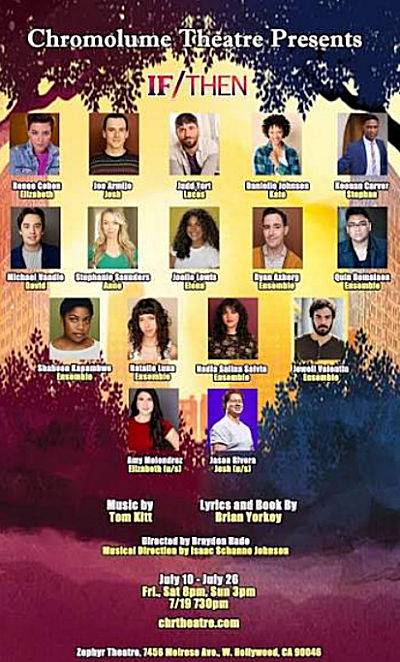
Other than the volume of the voices, the performances themselves were strong. Renee Cohen (who, looking back, once posted a comment my review of Hands on a Hardbody inviting her to see her in Cabaret) gave a great performance as Elizabeth / Liz / Beth. She had a bit of a Rock-y (as in Rock Music) singing voice with points of tenderness, and brought the character to life well. Normally, her tattoos would have bothered me (as I find they make me think of the actor as the actor, not their character), but they seemed to fit the age and character, so I was able to ignore them. Also strong was Jon Armijo as Josh. He had a strong voice and personality, and seemed to have chemistry with Cohen’s Liz.
Other notable main cast members were Danielle Johnson’s Kate, who brought a strong personality and singing voice to the character, as well as strong chemistry with Stephanie Saunders’ Anne. I also liked Judd York’s Lucas, who brought a nice playfulness to the stage. Lastly, we think we’ve seen Keenan Carver (who played Stephen) before, but he’s not coming up on a search.
Of the ensemble, standouts include Shaheen Kapambwe and Nadia Salina Salvia. Kapambwe had a number of small roles, but I think I detected between them a strong singing voice. Salvia also gave glimpses of her voice; I wonder what she could have done with the role of Elizabeth.
In terms of other aspects of the execution: It was hard to keep track of the various timeline threads based on character interactions alone. There were no real set clues, and although I think they tried to use costumes, it wasn’t really clear. The set itself was a podium, three black scenic boxes, and a bench; the back was some sort of hand-drawn graphic with the show’s name and some references to New York. One of the reviews reminded me that the tour used colored lights to show timelines. That might have helped here, but something was needed.
As for costumes: I think the memo was: wear something black or grey. Other than that, it seemed to be mostly street clothes, with some accessories to hint at profession: a doctor’s coat, a camouflage cap, a teacher’s (umm) cardigan. Chromolume does work on a minimal budget (and they lose money on each show, and can use more donations), so simple sets and costumes are not a surprise. However, design-wise, something stronger was needed to distinguish timelines.
Sound-wise, in addition to the volume problem of the music, there were some aural discongruities. A baby (prop) would be held on stage, and would supposedly cry, but the cry would come from offstage. Similarly, cell phones would be held but would ring offstage. These problems wouldn’t be noticed in a large theatre like the Pantages or Ahmanson. In a small theatre, sound location is, well, amplified. You can easily tell where the sound is coming from. Having some form of mid-stage speaker would have helped quite a bit here, and might have been patchable into the music sound system.
In terms of dance and movement: The space was covered well. There were no particular dance numbers that stand out in my memory.
So let’s do the bottom line, well, at the bottom. Should you go see If/Then at Chromolume? First, if you do, be quick. There’s one more performance this evening, so get your quickits tick, umm, tickets quick, if you decide to do so.
But should you go? Story and music wise, this isn’t a classic. It’s not as forgettable as some, but isn’t top tier either. The questions it raises are good one, and it does center a female professional. What is notable and worthy here is the execution: Yet again Chromolume attempts a show that has only been done on large stages, and stages it, with reasonable success, in a small black box theatre. Chromolume also does it with a show that is rarely done, and swings to see if a lesser known show can be successful. These efforts must be applauded and supported and encouraged. In a world of theatres doing remountings of The Wizard of Oz and The Sound of Music and Mamma Mia—all crowd pleasers but all overdone, be a Chromolum and do If/Then. Be a Pasadena Playhouse and do Brigadoon. Be a Group Rep and do Applause. Be a Conundrum and do Big Fish.
So, yes, if you can catch it, go see If/Then at Chromolume (at the Zephyr in Hollywood). The story isn’t perfect and there are some sound problems. But shows like this must be encouraged. While you’re at it, grab some great Uzbek food at Zira two doors down from the theatre.
Next up at Chromolume (in November): Stephen Sondheim’s Roadshow. Chromolume always does one Sondheim show per season, and this is another ambitious swing. The show hasn’t had a production in Los Angeles before; indeed, most folks forget about the show when they list Sondheim shows (or they think of it under its pre-Broadway name, Bounce). That, too, will be worth seeing.
Credits
If/Then. Music by Tom Kitt. Lyrics and book by Brian Yorkey. Directed by Brayden Hade. Choreography by Ellie Rodriguez.
Cast : Jon Armijo Josh; Ryan Axberg Ensemble; Keenan Carver Stephen; Renee Cohen Elizabeth / Liz / Beth; Quin Domalaon Ensemble; Danielle Johnson Kate; Shaheen Kapambwe Ensemble; Joelle Lewis Elena; Natalie Luna Ensemble; Nadia Salina Salvia Ensemble; Stephanie Saunders Anne; Christopher Jewell Valentin Ensemble; Michael Vandie David; Judd Yort Lucas. Understudies: Amy Melendrez u/s Elizabeth / Liz / Beth; Jason Rivera u/s Josh.
Music Department: Isaac Schanno Johnson Music Direction, Piano; Gage Getz Bass; Trinidad Rojas Drums.
Production and Creative: Brayden Hade Director, Scenic Design, Costume Design; Ellie Rodriguez Asst Director, Choreographer; Mary Zastrow Intimacy Director; Devin Harris Lighting Design; James Esposito Sound Design, VP Operations (Chromolume); Ashia Coleman Costume Design; Mara Aguilar Production Stage Manager; Deziree White-Virk Asst Stage Manager; Ken Werther Publicity. For Chromolume: James Esposito VP Operations; Bonnie Sludikoff Artist Coordinator; Nike Montelibano Marketing; Veronica Vasquez Casting Associate; Michael Angel Social Media Manager; Lizeth Olguin Moore Box Office Coordinator; Brianne Lopez-Cole House Manager; Christopher D. Baker Youth Program Director; Ken Werther Press Agent.
Administrivia
I am not a professional critic. I’m a retired cybersecurity professional, a roadgeek who does a highway site and a podcast about California Highways, and someone who loves live performance. I buy all my own tickets, unless explicitly noted otherwise. I do these writeups to share my thoughts on shows with my friends and the community. I encourage you to go to your local theatres and support them (ideally, by purchasing full price tickets, if you can afford to do so). We currently subscribe or have memberships at: Center Theatre Group/Ahmanson Theatre; Broadway in Hollywood/Pantages Theatre; Pasadena Playhouse; The Soraya, Chromolume Theatre, and 5-Star Theatricals.
Want to find a show: Check out the Theatre Commons LA show list. Other good lists are the Theatre in LA listings; the TodayTix listings; OnStage 411 (use the “shows” drop down); and Theatermania. If you are looking for discount tickets, TodayTix (unlike their predecessor Goldstar Events) doesn’t handle the small theatres in LA. Luckily, Theatre Source LA has a new initiative: StageRushLA for discount tickets.
Upcoming
Key: 🎭 Theatre / 🎼 Music /  Other Live Performance – Next 90ish Days (🎫 indicates ticketing is pending).
- August: 🎭 Beauty and the Beast at BIH/Pantages;
- September: 🎭 Water for Elephants at BIH/Pantages; 🎼 Sutton Foster at The Soraya; 🎭 The Visit at Pasadena Playhouse; 🎭Every Brilliant Thing at The Main; 🎭🎫 Catch Me If You Can at The Colony Theatre;
- October: 🎭 The Outsiders at BIH/Pantages; 🎼 Branford Marsalis & Dianne Reeves Celebrate John Coltrane at The Soraya; 🎭 Les Miserables at 5-Star Theatricals; 🎼 Gershwin and the Golden Age (feat. Michael Feinstein) at The Soraya; 🎭 The Who’s Tommy at BIH/Pantages.
- November: 🎭 Passing Strange at Pasadena Playhouse; 🎭 Oh Mary at CTG/Ahmanson; Dance Theatre of Harlem at The Soraya; 🎭 Road Show at Chromolume Theatre; 🎭 Destiny of Desire at CTG/Taper.
- December: 🎭 Candide at LA Opera; 🎼🎫 Go Jazz at The Main (Tent. Date); 🎭🎫 Big Fish at Conundrum; 🎼 Spanish Harlem Orchestra at The Soraya; 🎭 Christmas Carol Goes Wrong at CTG/Ahmanson.

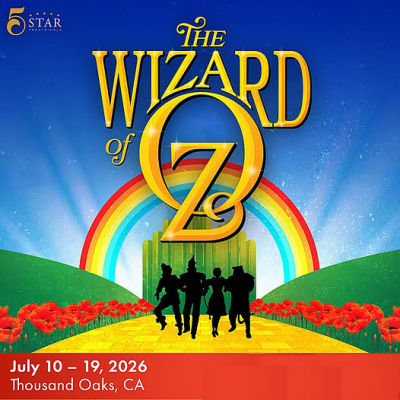
 There are some shows where you can just safely turn off your brain and be like a Scarecrow, because you know them so well. The Wizard of Oz is one of those shows. Why? Because, because, because, because, because… because of the wonderful… oh, right.
 When you think of a musical, what comes to mind? An orchestra in pit, perhaps on-stage in the back? Singers and dancers? Elaborately choreographed numbers?
 Mamma Mia.
 indicates local): Martin Koch
  Theatre /
  Music /
  indicates ticketing is pending).

 indicates 2026 Tony Award winning;
  indicates nominee.
 Way back in January 1980, I had the joy of seeing the original cast of Ain’t Misbehavin’ at the Aquarius Theatre on Sunset Blvd, as part of the National Tour of the show. It was then I fell in love with the music of Fats Waller and the performance of the original cast. The show was interesting. It was one of the first jukebox musicals performed. Through the performances and the songs, it loosely told the story of Fats Waller: his style, his popularity, his reception in the white vs. black communities, and his problems in life. Since then, when productions of the show have been mounted, I’ve tried to see them. I remember
 As of the time I’m writing this, I have 57,778 songs in my music library. However, until the musical Hell’s Kitchen popped onto the scene, I don’t think I had ever knowingly listened to a song by