Decision Paralysis | “If/Then” @ Chromolume

If/Then (Chromolume)Last night, we were down in Hollywood / West Hollywood to see the second mainstage musical in Chromolume‘s 2026 season of Identity and Expression. Chromolume is an interesting theatre company—one that takes very ambitious swings on a shoestring budget. With Chromolume, you will see shows you rarely see elsewhere, done in a constrained environment where creativity is required. I think the best example of this was a show in their previous location, where they managed to stage Sondheim’s Pacific Overtures in a tiny black-box space, with no wings, overhead, or scenery space. We’ve seen such a wide variety of shows we’ve never seen there, from Zanna Don’t to Dessa Rose to Prez. In their last mainstage show, they managed to stage the full musical The Color Purple in a 73 seat black box.

For their second mainstage show this season, Chromolume has mounted If/Then, a musical we last saw on tour at the Pantages back in 2015, with much of the original cast, including Idena Menzel, Anthony Rapp, and LaChanze.

First and foremost: My friend James Umbach should see this musical. It is rare to find a musical centered around a city urban planner.  [To explain, James, in addition to being a road person, is a city planner for the city of Fernley, NV]

As for the story itself, I’d like to take advantage of the synopsis and observations I wrote when we saw the show for the first time, as those comments still hold:

Science has a theory that every time anyone makes a decision, the universe splits. Each reality reflects the timeline from the decision point, following what would have happened for each way the decision could have gone. This creates an infinite number of alternate realities, reflecting all possible decisions. Many may be dead and lifeless; many may be almost identical. Each is self contained, with no way to know that the other realities exist.

If/Then shows the path of two of those realities as they apply to the life of Dr. Elizabeth Vaughan, an urban planner recently returned to New York City after the end of her college marriage. Both paths revolve around the interaction of Elizabeth and her friends: Lucas (a college friend and housing activist); Kate (a lesbian kindergarten teacher who lives across the hall from Elizabeth); Stephen (another college friend and an urban planner with the City of New York); and Josh (an Army doctor just returned from a tour of duty, who meets Elizabeth in the park).

Let’s pause at this point. Alternate realities are “in”. As I write this, a Big Bang Theory spinoff (“Stuart Fails to Save the Universe”) has just premiered on HBO Max that is centered on alternate realities. We’ve had loads of Spiderman movies based on alternate realities. It’s a popular theme, and a great basis for the exploration of the question “What If?” (in fact, that’s the starting and ending song of this show). So as the basic premise for a show it is a promising idea. Back to my 2015 synopsis:

In one path (the “Liz” path, so-called because Elizabeth is called “Liz” in this path), Liz follows the advice of Kate: she makes the wild choices. She goes into academia, starts dating the man she just met (Josh), and works to build a family and friends.

In the other path (the “Beth” path), Beth follows the advice of Lucas: she accepts a job doing urban planning for the city, and dedicates her life not to love but to work, moving up the urban planning life, working for Stephen.

In both cases, the “ideal” life goes in an uncertain direction in the second act, concluding with Beth/Liz getting the opportunity to start over. You can find a more detailed summary with the various plot twists over on Wikipedia.

The presentation of the alternate realities keeps intertwining the two timelines: songs often keep going back and forth from one line to the other during the song.  Contrast this with The Last 5 Years, which also has two timelines, but keeps them separate except for one meeting point. How do you keep track of which line you are in?  By what characters are around, their demeanor, and by what Elizabeth is called.

In reading the reviews before the show, I’ve seen critics all over the map regarding the story (an original story by Brian Yorkey) and the music/lyrics (music by Tom Kitt and lyrics by Brian Yorkey). Some like it; some find it “meh”. I actually enjoyed the story and seeing the multiple lines. If I had one quibble story-wise, it is that the show is far too New York City centric. I understand that to New Yorkers and to those who work on Broadway, New York City is the center of the universe — but it really isn’t. The 33 square miles of Manhattan is just a drop compared to most megalopolises.  The constant dropping of references to New York communities and institutions is confusing to the non-New York audiences, and the New York specific references in the projects provide no meaning or clues to those that know not New York. But the worst part is: none of them are necessary. The story would work just the same in any other major city (with some joke adjustments). This makes the New York attitude come off with a sense of “we’re better and cooler than you” — which will play great on Broadway, but lands with a thud elsewhere, thankyouverymuch.

Let’s pause again at this point. By the time a show moves out of the original production and the original tour, the story is effectively cast in stone. Regional, local, intimate theatre, etc. remountings are constrained by the story’s problems (and often, by the original’s design and constraints—I was just reading a post on Reddit about how some productions of Mamma Mia are constrained in how they can advertise the show). What this means is that we can’t really blame Chromolume for basic plot or music problems: their only involvement was choosing the show for the season, and their subsequent execution of the show. So in terms of the show itself, the choice was reasonable: This show hasn’t been mounted in Los Angeles since the original tour 10 years ago; the venue and budget is so different that the ambition of this attempt is to be applauded independent of any inherent problems in the show itself.

That said, back to the last paragraph of the quoted comment. This show is far too New York centric. New Yorkers seem to love shows centered in New York; they think there city is the best in the world. Los Angeles would beg to differ on that point. But more importantly, unless New York is a vital element to the plot and story, it should not be the centering. In such cases, the centering is clearly pandering to a Broadway audience who wants to worship their city. But when the show has its subsequent productions out of NYC, it helps it fall flat. In this case, there are really only two New York specific things to the story: a meet-cute in the subway, and using the Mets/Yankees for a distinction in a song. Well, city planning takes place in many many cities; many cities have urban transportation systems and multiple sports teams. This could have been in Chicago or St. Louis or even San Francisco, and it would have worked.

Moving past that rant (as you might have guessed, I’m native Los Angeles, and have no desire to live in New York—and that applies to Broadway as well, for Los Angeles has its own vibrant theatre community that I’d match with any city). This show itself has other problems. Here’s more of what I wrote in 2015:

This brings us to the music of the show. Going in, I had heard the album — in fact, I had heard the album with this cast (which is now something rare to get in Los Angeles (ah, for the days when the LACLO usually brought in the Broadway stars)). I had actually liked the music quite a bit — if I look in my iTunes, 60% of the songs are starred as favorites. Some songs are particularly cute — such as “What the Fuck?”; others are very touching. I particularly liked “You Learn to Live Without”, which is a lovely counterpoint to “Who Gave You Permission?” from Ballroom. Both looked at dealing with the aftermath of death: one with acceptance and moving forward, the other with anger. About my only problem with the music was volume — at times, it tended to overpower the voices.

Ten years lager, and about the only song that I remember from the show is “What the Fuck?”. The music, simply put, is pretty unmemorable. Kitt and Yorkey can do memorable songs; just look at Next to Normal. This show comes across as a less memorable effort.

The story has one other major problem. As noted, the basic question is the story is: What path should Elizabeth take to make her life complete? But none of the choices involve Elizabeth being a success without dependence on a relationship. Why is it that a man can find happiness and success in a career, but a woman requires a relationship to be successful? Elizabeth has strong friends, a great career as an urban planner, in (to quote Hamilton ) “the greatest city in the world”. So what (or who) is Elizabeth, independent of any romantic relationship with a man? I’m not sure the book of this show has an answer.

We’ve talked about some weaknesses of the show. What are some of the strengths? First and foremost, centering a story about a female technical professional is a great thing. I noted this back in 2015, saying “This is a wonderful role model for the girls in the audience, and deserves extra applause.” The show also shows somewhat realistic same-sex relationships: not just male-male, but female-female. This was on the edge back in 2014 when the show was on Broadway (same-sex marriage was a new thing then); it is still good to see such relationships portrayed without a lot of stereotypes.

The show also raises some good questions. There are far too many folks these days who get stymied by decision paralysis. Games know this well: In trying to decide your next move, you get stuck analyzing the possibilities and payoffs. If there’s a point to this show, it is: Don’t overthink, just do. Take that chance. That’s a reasonable point to make.

Let’s now turn from the show itself to this particular production. As many reviewers have noticed, this show suffered from the same problem I noted on tour: “About my only problem with the music was volume — at times, it tended to overpower the voices.” The same was true here, and especially so as the performers had no amplification. The volume on the music needed to be turned down where possible: the amp on the keyboard and the bass in particular. The director also needed to emphasize to the actors to project their voices so that they could be heard clearly throughout the small space. There were segments and dialogue that could not be heard where we were sitting—and we were in the second row on stage left. I think actors today are trained to speak as if they were amplified (and this is certainly true for actors who work predominantly in TV and films); it is a different skill to learn to perform without amplified voices, and directors in unamplified venues need to remind their performers of this.

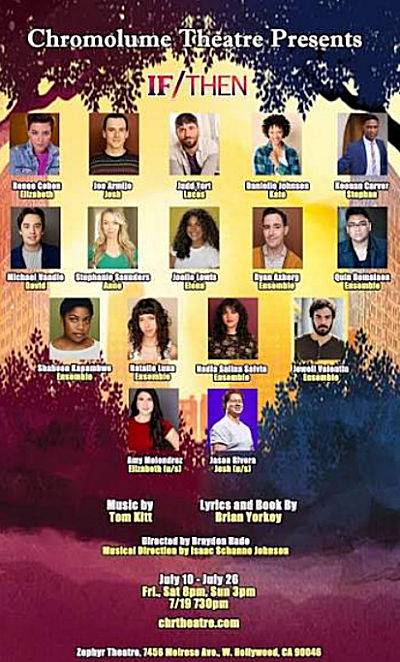
Other than the volume of the voices, the performances themselves were strong. Renee Cohen (who, looking back, once posted a comment my review of Hands on a Hardbody inviting her to see her in Cabaret) gave a great performance as Elizabeth / Liz / Beth. She had a bit of a Rock-y (as in Rock Music) singing voice with points of tenderness, and brought the character to life well. Normally, her tattoos would have bothered me (as I find they make me think of the actor as the actor, not their character), but they seemed to fit the age and character, so I was able to ignore them. Also strong was Jon Armijo as Josh. He had a strong voice and personality, and seemed to have chemistry with Cohen’s Liz.

Other notable main cast members were Danielle Johnson’s Kate, who brought a strong personality and singing voice to the character, as well as strong chemistry with Stephanie Saunders’ Anne. I also liked Judd York’s Lucas, who brought a nice playfulness to the stage. Lastly, we think we’ve seen Keenan Carver (who played Stephen) before, but he’s not coming up on a search.

Of the ensemble, standouts include Shaheen Kapambwe and Nadia Salina Salvia. Kapambwe had a number of small roles, but I think I detected between them a strong singing voice. Salvia also gave glimpses of her voice; I wonder what she could have done with the role of Elizabeth.

In terms of other aspects of the execution: It was hard to keep track of the various timeline threads  based on character interactions alone. There were no real set clues, and although I think they tried to use costumes, it wasn’t really clear. The set itself was a podium, three black scenic boxes, and a bench; the back was some sort of hand-drawn graphic with the show’s name and some references to New York. One of the reviews reminded me that the tour used colored lights to show timelines. That might have helped here, but something was needed.

As for costumes: I think the memo was: wear something black or grey. Other than that, it seemed to be mostly street clothes, with some accessories to hint at profession: a doctor’s coat, a camouflage cap, a teacher’s (umm) cardigan. Chromolume does work on a minimal budget (and they lose money on each show, and can use more donations), so simple sets and costumes are not a surprise. However, design-wise, something stronger was needed to distinguish timelines.

Sound-wise, in addition to the volume problem of the music, there were some aural discongruities. A baby (prop) would be held on stage, and would supposedly cry, but the cry would come from offstage. Similarly, cell phones would be held but would ring offstage. These problems wouldn’t be noticed in a large theatre like the Pantages or Ahmanson. In a small theatre, sound location is, well, amplified. You can easily tell where the sound is coming from. Having some form of mid-stage speaker would have helped quite a bit here, and might have been patchable into the music sound system.

In terms of dance and movement: The space was covered well. There were no particular dance numbers that stand out in my memory.

So let’s do the bottom line, well, at the bottom. Should you go see If/Then at Chromolume? First, if you do, be quick. There’s one more performance this evening, so get your quickits tick, umm, tickets quick, if you decide to do so.

But should you go? Story and music wise, this isn’t a classic. It’s not as forgettable as some, but isn’t top tier either. The questions it raises are good one, and it does center a female professional. What is notable and worthy here is the execution: Yet again Chromolume attempts a show that has only been done on large stages, and stages it, with reasonable success, in a small black box theatre. Chromolume also does it with a show that is rarely done, and swings to see if a lesser known show can be successful. These efforts must be applauded and supported and encouraged. In a world of theatres doing remountings of The Wizard of Oz and The Sound of Music and Mamma Mia—all crowd pleasers but all overdone, be a Chromolum and do If/Then. Be a Pasadena Playhouse and do Brigadoon. Be a Group Rep and do Applause.  Be a Conundrum and do Big Fish.

So, yes, if you can catch it, go see If/Then at Chromolume (at the Zephyr in Hollywood). The story isn’t perfect and there are some sound problems. But shows like this must be encouraged. While you’re at it, grab some great Uzbek food at Zira two doors down from the theatre.

Next up at Chromolume (in November): Stephen Sondheim’s Roadshow. Chromolume always does one Sondheim show per season, and this is another ambitious swing. The show hasn’t had a production in Los Angeles before; indeed, most folks forget about the show when they list Sondheim shows (or they think of it under its pre-Broadway name, Bounce). That, too, will be worth seeing.

Credits

If/Then. Music by Tom Kitt. Lyrics and book by Brian Yorkey. Directed by Brayden Hade. Choreography by Ellie Rodriguez.

Cast : Jon Armijo Josh; Ryan Axberg Ensemble; Keenan Carver Stephen; Renee Cohen Elizabeth / Liz / Beth; Quin Domalaon Ensemble; Danielle Johnson Kate; Shaheen Kapambwe Ensemble; Joelle Lewis Elena; Natalie Luna Ensemble; Nadia Salina Salvia Ensemble; Stephanie Saunders Anne; Christopher Jewell Valentin Ensemble; Michael Vandie David; Judd Yort Lucas. Understudies: Amy Melendrez u/s Elizabeth / Liz / Beth; Jason Rivera u/s Josh.

Music Department: Isaac Schanno Johnson Music Direction, Piano; Gage Getz Bass; Trinidad Rojas Drums.

Production and Creative: Brayden Hade Director, Scenic Design, Costume Design; Ellie Rodriguez Asst Director, Choreographer; Mary Zastrow Intimacy Director; Devin Harris Lighting Design; James Esposito Sound Design, VP Operations (Chromolume); Ashia Coleman Costume Design; Mara Aguilar Production Stage Manager; Deziree White-Virk Asst Stage Manager; Ken Werther Publicity. For Chromolume: James Esposito VP Operations; Bonnie Sludikoff Artist Coordinator; Nike Montelibano Marketing; Veronica Vasquez Casting Associate; Michael Angel Social Media Manager; Lizeth Olguin Moore Box Office Coordinator; Brianne Lopez-Cole House Manager; Christopher D. Baker Youth Program Director; Ken Werther Press Agent.

Administrivia

I am not a professional critic. I’m a retired cybersecurity professional, a roadgeek who does a highway site and a podcast about California Highways, and someone who loves live performance. I buy all my own tickets, unless explicitly noted otherwise. I do these writeups to share my thoughts on shows with my friends and the community. I encourage you to go to your local theatres and support them (ideally, by purchasing full price tickets, if you can afford to do so). We currently subscribe or have memberships at: Center Theatre Group/Ahmanson TheatreBroadway in Hollywood/Pantages TheatrePasadena PlayhouseThe SorayaChromolume Theatre, and 5-Star Theatricals.

Want to find a show: Check out the Theatre Commons LA show list. Other good lists are the Theatre in LA listings; the TodayTix listings; OnStage 411 (use the “shows” drop down); and Theatermania. If you are looking for discount tickets, TodayTix (unlike their predecessor Goldstar Events) doesn’t handle the small theatres in LA. Luckily, Theatre Source LA has a new initiative: StageRushLA for discount tickets.

Upcoming

Key: 🎭 Theatre / 🎼 Music / 🎙 Other Live Performance – Next 90ish Days (🎫 indicates ticketing is pending).


Share

🎭 And We’re Off … Again | “The Wizard of Oz” @ 5-Star Theatricals

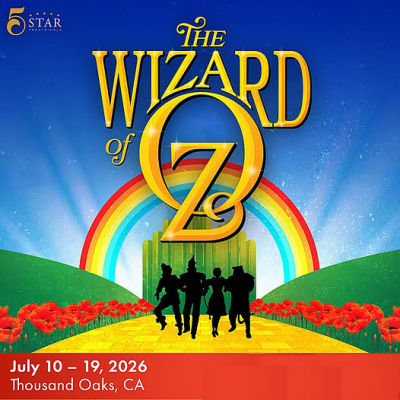
Wizard of Oz (5-Star Theatricals)There are some shows where you can just safely turn off your brain and be like a Scarecrow, because you know them so well. The Wizard of Oz is one of those shows. Why? Because, because, because, because, because… because of the wonderful… oh, right.

When I learned of the 5-Star season and the fact they would be doing The Wizard of Oz as their summer musical in the large theatre, my first thought was: Sigh, not again. My second thought was: Well, it will bring in the families.

The good news is that the show was as entertaining as it always is. You know the stage version from the movies, and it doesn’t veer that far from that source. Not a single reference to Elphaba or GALinda or that upstart version from Stephen Schwartz. The bad news is: It didn’t draw them in. We were there for the second Saturday night, and the Orchestra section of the Kavli was barely 50% full. This is bad news for 5-Star, which has already downsized two of its shows to the smaller Scherr Forum. Back in the Cabrillo Theatre days, the Orchestra was full, the Mezzanine was mostly full, and the upper Balcony was about half-full. The quality of the shows hasn’t gone down, so all I can surmise is that the economy is hitting the discretionary pocketbook. This is bad news for 5-Star in a number of ways. First, they will stay with safer shows that will draw folks in instead of the lesser-known gems they used to occasionally do. Second, it will impact them in the pocketbook, hurting their ability to be in the community doing the things they love. Third, it might well impact their future survival. On the hopeful side, there was a note in the program about a “bold new educational initiative” that was about to take center state, and is “built to inspire, teach, and nuture our youth with programs that expand beyond the stage”. My guess is that this “academy” is a youth training program similar to the classes that the Pasadena Playhouse has started, and the Rubicon is doing in Ventura. I’m not aware of a major program like that in the Thousand Oaks/Camarillo area (although there is the Hillcrest Center for the Arts/YAE and Camarillo Jr Theatre, but 5-Star has a much stronger cache, and a much-stronger pipeline to industry. It could well save the company, much more so than donations.

Back to the Wizard of Oz. When I heard that 5-Star was doing the show, I was wondering if they would license the most recent version of the show with the additional songs by Andrew Lloyd Weber. I had heard those songs, but haven’t seen them in concert. Alas, that’s not the version they licensed. Instead, they went with the 1987 Royal Shakespeare Version. Distinguishing characteristics of this version are: (a) they add the opening introductory verses to “Over the Rainbow”, “If I Only Had {A Brain, A Heart, The Nerve}” and “Merry Old Land of Oz”; (b) they double-role Aunt Em with Glinda, and Uncle Henry with the Guard; (c) they add back in the Jitterbug dance to Act II to tire our heroes out before they are taken to the Witch; and (d) they add some reprises of songs in the second act because the movie has a dearth of songs there. Of the versions available, this is probably the best, as the 1942 MUNY version is strange (although far too many folks just make up their own versions, as this strange mashup of Wizard of OzThe Wiz, and much more that Nobel MS did ages ago)

As with any of these old musical chestnuts (cough, The Sound of Music, cough), the key distinguishing factor is the execution. This is 5-Star’s strength. They cast using primarily local talent (and often serve as a stepping stone to better places, be it Broadway or National Tours). They use very talented directors; in this case Richard Israel who is an expert at musicals. They used to do their own sets, but now they rent great ones (which saves both cost and waste). Their contracted orchestra is top-notch.

This production was no exception. The on-stage talent was great, although the ensemble and the children’s ensemble was a bit female heavy (especially in the Munchkin sequence, it was obvious with the Mayor, officials, and Coronor being female). As Dorothy, the lead Hannah Sedlacek did a great job (although her look was atypical for one used to Judy Garland). She sang very strongly, was an equally strong dancer, and was able to handle Toto well. It was also a delight watching her face: There were some sequences where you could see the behavior of the Lion was just cracking her up.

The team-of-three was equally strong. Most notable was Tom Anawalt as the Lion/Zeke, who brought loads of physical humor and playfulness to the role. Lucas Alifano brought strong dancing and characterization to Tin Man/Hickory, and Eric Stanton Betts had the appropriate loose-limbness needed for a Scarecrow with no bonds. Watch their dancing during the Jitterbug number, or their playfulness during “King of the Forest”, and you would see what I mean.

Cassandra Marie Murphy was strong as Em/Glinda (and I love how they changed crullers to cookies, which are probably easier to obtain in Thousand Oaks). Becky Lythgoe made a strong witch, although the shade of green on her face was a bit too bright.

And then there was total, played by Winnie. A papillion/terrier mix, it was quite a bit of fun to watch her reactions to what was going on around her on stage.

The ensemble sang and danced well, especially Gibson Day and Nick Ley, who were easy to identify. But all of them were strong.

Turning to the production side: In general, the production was strong. I appreciated that they attempted to reproduce the sepia-toned nature of the opening and the closing, and the execution of the tornado was a great way to achieve a lot with a little. I took issue with the colors of Munchkin-land and the colors of the Emerald City. The books defined a specific color scheme for the lands of Oz: blue for Munchkins in the East, yellow for Winkies in the West, red for Quadlings in the North, green for the Emerald City in the Center, and (in works after the first) purple for the Gillikins in the South, which region was also not named in the first book. However, in the 5-Star stage version, the dominant color in the Munchkin scenes was red. That threw me off: they should have emphasized the blue. Similarly, in the Emerald City (which, traditionally, is green because everyone is required to wear green glasses, but only The Wiz and Wicked got that right), they had a number of the female dancers with bare or yellow stockinged legs. Green stockings or green pants should have been used.

Other technical aspects worked well (module some problems with one segment of the Yellow Brick Road). They had a nice walkway over the orchestra, costumes were generally quite good (especially for the Jitterbugs), and the flying effects were well used.

The Orchestra, as always, was quite strong. I’ve never heard a bad 5-Star orchestra.

Alas, as I am typing this the final performance is occurring. “Watch this space”, as 5-Star will be doing Les Miz in the smaller Scherr Forum space in October. That should be interesting to see.

Credits

The Wizard of Oz. By L. Frank Baum. With music and lyrics by Harold Arlen and E. Y. Harburg. Background music by Herbert Stothart. Adapted by John Kane for the Royal Shakespeare Company. Based on the classic MGM motion picture owned by Turner Entertainment Co. and distributed in all media by Warner Brothers.

Cast (æ indicates Actors Equity): Hannah Sedlacek Dorothy Gale; Winnie Toto; Cassandra Marie Murphyæ Aunt Em / Glinda; Mike Baker Uncle Henry / Emerald City Guard; Noah Kaplan Professor Marvel / Wizard of Oz; Becky Lythgoeæ Miss Gulch / Wicked Witch of the West; Eric Stanton Bettsæ Scarecrow / Hunk; Lucas Alifanoæ Tin Man / Hickory; Tom Anawalt Cowardly Lion / Zeke. Ensemble: Aaron Michael-Rees Camitses, Ali Marquez-Qadiri, Amanda Kang, Angelica Roque, Bar Daniel, Barbara Ann Reed, Bayley Tanenbaum, Calista Zajac, Jacob Ray, Josh Igarashi, Lauren Lorati, Nicholas Ley, Samantha Bell, Sam Davidson, Spencer Reese Sharp, Xavier F. Reynoso. Youth Ensemble: Ameline Lynch, Anna Marie Holland Melendrez, CC Adeva, Gibson Day, Kaylie Cho, Malia Johnson, Ryan Bohmholdt.

Music Department: Anthony Lucca Music Director / Conductor; Peter Howard Dance and Vocal Arrangements; Larry Wilcox Orchestrations; Rhondda Dayton Flute, Piccolo, Recorder; Ian Dahlberg Oboe, English Horn; Darryl Tanikawa Clarinet, Bass Clarinet, Alto Sax, Orchestra Contractor; Gary Rautenberg Tenor Sax, Flute, Clarinet; Matt Germaine Baritone Sax, Flute, Clarinet; Melissa Hendrickson Horn I; Jennifer Bliman Horn II; Bill Barrett Trumpet I; Chris Maurer Trumpet II; Nathan Stearns Trombone, Bass Trombone; Sharon Cooper Violin I, Concertmaster; Cyndi Hall Violin II; Bang-Eunn Lee Cello; Andrew Lederman String Synthesizer; Elaine Lister Harp; Chris Kimbler Piano, Celeste; Shane Harry Double String Bass; Alan Peck Set Drums; Tyler Smith Percussion; Tanikawa Artists Management LLC Orchestra Producer.

Production and Creative: Richard Israel Director; Clarice Ordaz Choreographer; Brittany Lorin Assoc. Choreographer; Olivia Riddle Production Stage Manager; Ava Ferreira Asst Stage Manager; Jonathan A. Burke Sound Design; Julia Pinhey Asst Sound Design; Isa Underdahl Sound Engineer; Brandon Baruch Lighting Design; Alex Choate Prop Design; Luis Martinez Wig / Hair / Makeup Design; Christine Steele / Gail Garon Wardrobe Coordinators; Tuacahn Costume Rentals Costumes; The Music and Theatre Company Scenic Elements; EK Dagenfield Production Manager; Jack Allaway Technical Director; Jacob Holcombe Deck Captain; Michael Donovan CSA and Richie Ferris CSA Casting; Fresh Interactive Marketing; David Elzer / Demand PR Publicity.

Key Producers: Cindy Murray Executive Director 5-Star/Producer.

Administrivia

I am not a professional critic. I’m a retired cybersecurity professional, a roadgeek who does a highway site and a podcast about California Highways, and someone who loves live performance. I buy all my own tickets, unless explicitly noted otherwise. I do these writeups to share my thoughts on shows with my friends and the community. I encourage you to go to your local theatres and support them (ideally, by purchasing full price tickets, if you can afford to do so). We currently subscribe or have memberships at: Center Theatre Group/Ahmanson TheatreBroadway in Hollywood/Pantages TheatrePasadena PlayhouseThe SorayaChromolume Theatre, and 5-Star Theatricals.

Want to find a show: Check out the Theatre Commons LA show list. Other good lists are the Theatre in LA listings; the TodayTix listings; OnStage 411 (use the “shows” drop down); and Theatermania. If you are looking for discount tickets, TodayTix (unlike their predecessor Goldstar Events) doesn’t handle the small theatres in LA. Luckily, Theatre Source LA has a new initiative: StageRushLA for discount tickets.

Upcoming

Key: 🎭 Theatre / 🎼 Music / 🎙 Other Live Performance – Next 90ish Days (🎫 indicates ticketing is pending).


Share

🎭 Protecting Those Different | “Mexodus” @ Pasadena Playhouse

Mexodus (Pasadena Playhouse)When you think of a musical, what comes to mind? An orchestra in pit, perhaps on-stage in the back? Singers and dancers? Elaborately choreographed numbers?

Set that all aside when you see Mexodus at the Pasadena PlayhouseMexodus is a very non-traditional musical, at least in that respect. All of the music is created live by the two performers telling the story. And when I say created, I literally mean created. Not only do they play all the instruments, but the record and loop those instruments and background sounds live as they perform the story. They then play them back as they tell the story to provide their own generated backing tracks. It is a very unique way of presenting a musical. Additionally, not only are these two the performers, they are also the authors: all the music and lyrics and story are by Brian Quijada and Nygel D. Robinson, who perform the show.

Oh, and there are no traditional song and dance numbers, but that’s less surprising with a cast of only two.

As for the show itself, well, an article in Playbill describes it best:

When the two began working on it five years ago, they were still relative strangers. Back in February 2020, Quijada and Robinson were both speakers at a conference for actors who were also musicians. The two immediately got along: they both played multiple instruments, they loved hip-hop and musical theatre, and they grew up going to church.

After the conference, the two were hanging out at Quijada’s small studio apartment “just rapping and vibing and stuff,” recalls Robinson. “But he was like, ‘Have you ever heard of the Underground Railroad that led south to Mexico? And I was like, ‘oh shit. That does make sense.’”

Quijada had seen a History.com article about the Underground Railroad to Mexico on Facebook. “I remember reading that and thinking about my parents and their story of crossing the border,” says Quijada. He jotted that factoid down in 2017 as an interesting idea for a potential piece, but didn’t touch it until 2020, after he met Robinson, because, “I’m not going to write a slave narrative alone. That’s not my story.” Quijada’s parents are from El Salvador.

During the COVID-19 pandemic, as the theatre industry was shut down, Robinson and Quijada passed the time writing songs for Mexodus, bringing in their love of hip-hop and also gospel and bolero. The goal was to have enough songs to do a concert in 2021 at the development hub New York Stage and Film. Scholarship about the Underground Railroad to Mexico was scarce, but the two were able to find some compelling stories—such as the story about a slave who crossed the Rio Grande on a bale of floating cotton. Admits Robinson: “We don’t know if it’s a folk tale that happened for real, for real. But just the idea that the thing that enslaves you can be the thing that sets you free—that is the bigger metaphor.”

So Mexodus  tells the story of Henry, a slave from Victoria TX, and Carlos, a former Mexican army medic turned ranchworker across the border in Mexico (probably in the Neuvo Leon province). After having killed his master when his masters wife made sexual overtures to him (and the master caught them), Henry escapes across the Rio Grande floating on a bale of cotton. Carlos rescues him. The story the develops shows how the two became friends, and they provided protection for each other.

But more than this surface story, there are some key underlying messages. It starts at the very beginning, when Quijada tells a story about his youth in Chicago when they had to stop to get gas in a Black neighborhood. His parents were scared for their safety, simply because the people around them were different. He emphasizes how this shows that the attitudes America held during slavery: fear about people who were different, and only feeling comfortable around “your own” were still present today. He implies that a lot of this fear is what is driving what we are seeing today: People that are only comfortable with their own, and the immense fear many people have over those who are black and brown. They don’t see them as people; they see them only as the archetypes to be feared.

My wife said it well: She came into see a play, and came out having learned history. According to the History.com article that likely inspired the story, “Researchers estimate 5,000 to 10,000 people escaped from bondage into Mexico”. Mexico abolished slavery in 1829 when Texas was still part of the country, in part prompting white, slave-holding immigrants to fight for independence in the Texas Revolution. Once they formed the Republic of Texas in 1836, they made slavery legal again, and it continued to be legal when Texas joined the U.S. as a state in 1845. Mexico refused to sign a treaty equivalent to the Fugitive Slave Act, insisting that all enslaved people were free when they set foot on Mexican soil. Despite this, some U.S. owners of enslaved people still hired slave catchers to illegally kidnap escapees in Mexico. This is also a plot beat in the story.

Robinson makes it appear that his family history includes escaped slaves that went to Mexico. Whether this is true is hard to know, but he does make it believable. As such, this is a layer above histories such as Hamilton: This appears to be the real story of the performers telling the story.

The music is complex, and is not your traditional Musical style. It is hip-hop, and Tejano, and gospel, and so much more. It is also complex and developed. Again, quoting from the Playbill article:

The two act while singing and playing every musical instrument in the show. There’s no backing orchestra here—it’s just these two performers, some guitars, a bass, a piano, a trumpet, and drums. Oh, and the most important instrument of all: a looping station, which allows them to record a musical phrase and then play it back in repeat, so they can then layer multiple instruments on top of each other. This means that Quijada and Robinson are creating the arrangement for each song live on the spot every night. […] The musical complexity of Mexodus means that it doesn’t always go smoothly, notes Robinson. “It’s so complicated and the margin for error is so thin, like, if we hit [a button] a millisecond too late, we could derail three songs. I wish I was being hyperbolic. There have been some things that have messed up on our part, even in this run—like running up the steps and accidentally hitting the button and not meaning to. It’s like, ‘Why did that not record?’” They asked me if I noticed a mistake that occurred on the night I went to the show. I can honestly say that no, I couldn’t tell, because I was so swept away by the music I was hearing.

I can attest to that. At our performance, Quijada was having trouble with the peg at the bottom of his guitar that holds the strap. He kept fiddling it, while still trying to keep the music going and having the loop and record. He did, and he even joked live about it during the show. Both Quijada and Robinson give shoutouts to the technical and sound crew assisting them with the looping. They deserved it.

That’s yet another reason to see this musical. Often, when I see musicals, I assess their ability to move to the regional or school stage. Mexodus is technically complicated and requires sophisticated technology, and multi-talented musicians to pull it of. This is not a show likely to be seen on the regional or school stage. Pasadena Playhouse was able to remount this by bringing in the original Off-Broadway cast, including the original looping system architect. I’ll note that if you are interested in this production, it has been recorded and is available on Audible. I’m not sure I like that trend: I prefer traditional cast albums. Perhaps one day they will release just the songs as a cast album; for now, just one song has been released.

The show is short: Just 90 minutes with no intermission. It is well worth seeing, especially if you would like to learn some history you probably never knew. Oh, and the music is great as well.

Credits

Mexodus. Written and performed by Brian Quijada and Nygel D. Robinson. Directed by David Medizábal. Choreographed by Tony Thomas.

Cast: Brian Quijada Carlos; Nygel D. Robinson Henry. Understudies: Trent Lawson Henry; Alan Mendez Carlos.

Production and Creative: Brian Quijada Co-Creator; Nygel D. Robinson Co-Creator. David Medizábal Director, Costume Designer;  Tony Thomas Choreographer; Alan Mendez u/s Carlos, Music Director; Riw Rakkulchon Scenic Designer; Mextly Couzin Lighting Designer; Mikhail Fiksel Looping System Architecture & Sound Designer; Johnny Moreno Video/Projection Design; Hope Villaueva Production Stage Manager; Fior Tat Asst Stage Manager; Mike Deyo Assoc Sound Designer; Hide Nakajo Asst Sound Designer; Matt Perosa Deck Chief; Jordan Del Pino, Joe Court Audio Engineer A1; Akari Izumi Audio Engineer A2.

Key Producers: P3 Productions, Audible. Originally produced by Baltimore Center Stage. West Coast Premiere produced by Berkeley Repertory Theatre.

Administrivia

I am not a professional critic. I’m a retired cybersecurity professional, a roadgeek who does a highway site and a podcast about California Highways, and someone who loves live performance. I buy all my own tickets, unless explicitly noted otherwise. I do these writeups to share my thoughts on shows with my friends and the community. I encourage you to go to your local theatres and support them (ideally, by purchasing full price tickets, if you can afford to do so). We currently subscribe or have memberships at: Center Theatre Group/Ahmanson TheatreBroadway in Hollywood/Pantages TheatrePasadena PlayhouseThe SorayaChromolume Theatre, and 5-Star Theatricals.

Want to find a show: Check out the Theatre Commons LA show list. Other good lists are the Theatre in LA listings; the TodayTix listings; OnStage 411 (use the “shows” drop down); and Theatermania. If you are looking for discount tickets, TodayTix (unlike their predecessor Goldstar Events) doesn’t handle the small theatres in LA. Luckily, Theatre Source LA has a new initiative: StageRushLA for discount tickets.

Upcoming

Key: 🎭 Theatre / 🎼 Music / 🎙 Other Live Performance – Next 90ish Days (🎫 indicates ticketing is pending).

Share

🚘 Headlines About California Highways – June 2026

It’s hard to believe, but we’ve reached the half-way point of 2026, and the one-year point since I retired. This highway stuff has been keeping me busy, combined with my work on ACSAC.
California Highways: Route by Route logoTurning to the California Highways: Route by Route podcast: Tom and I have one more episode to record for the formal part of Season 4, plus some bonus episodes that we have planned. I’ll be starting the writing of Season 5 in the next week or so. Zencaster is working well for recording the podcast, although it was my turn for microphone trouble in the last episode. Hopefully, we’ll have that worked out in Ep 4.13. As a reminder: You can help our listening audience grow. Please tell your friends about the podcast, “like”, “♥”, or “favorite” it, and give it a rating in your favorite podcatcher. Share the podcast on Facebook groups, and in your Bluesky and Mastodon communities. For those that hear the early episodes, the sound quality of the episodes does get better — we were learning. If you know sound editing, feel free to give me advice (I use Audacity to edit). As always, you can keep up with the show at the podcast’s forever home at https://www.caroutebyroute.org , the show’s page on Spotify for Creators, or you can subscribe through your favorite podcatching app or via the RSS feeds (CARxR, Spotify for Creators) . The following episode has been posted this month:

  • June | CA RxR 4.12: Route 14, Route 64, LRN 290: The Valley Freeways that Never Happened. Episode 4.12 starts our exploration of the last route of this season: Route 14. Segment (a) of Route 14 is the unbuilt “Reseda to the Sea” freeway, so we take this opportunity to discuss the unbuilt freeways of the San Fernando Valley: the Reseda Freeway (Route 14), the Whitnall Freeway (Route 64), the Laurel Canyon Freeway (Route 170), and the freeway plans for Sunland Tujunga, the Angeles National Forest (Route 118, Route 122, Route 249), and the plan for the Mulholland Expressway (Route 268). We also discuss LRN 14 (part of US 40) and Sign Route 14 (which became Route 91). We’ll discuss the built portion of Route 14 between I-5 and US 395 in the last official season 4 episode. With respect to Tom’s sound quality: It’s better. Daniel’s mic has an occasional “pop” or “thump” problems; we’ll hopefully fix that in Ep 4.13. We’re also working to line up 2-3 bonus episodes during the season break. (Spotify for Creators)

As a reminder: One of the sources for the highway page updates (and the raison d’etre for for this post) are headlines about California Highways that I’ve seen over the last month. I collect them in this post, which serves as fodder for the updates to my California Highways site, and so there are also other pages and things I’ve seen that I wanted to remember for the site updates. Lastly, the post also includes some things that I think would be of peripheral interest to my highway-obsessed highway-interested readers.

Well, you should now be up to date. Here are the headlines that I found about California’s highways for June 2026:

Key

[Ħ Historical information |  Paywalls, $$ really obnoxious paywalls, and  other annoying restrictions. I’m no longer going to list the paper names, as I’m including them in the headlines now. Note: For paywalls, sometimes the only way is incognito mode, grabbing the text before the paywall shows, and pasting into an editor. See this article for more tips on bypassing paywalls. $$ paywalls require the use of archive.ph. ☊ indicates an primarily audio article. 🎥 indicates a primarily video article. 🎩 indicates hat/tip to someone for finding this article. ✔ indicates that the article was processed as part of the recent “Updates to California Highways” cycle. ]

Highway Headlines

  • ✔ A decades-old truck ban on I-580 could end. Oakland residents are upset (Oaklandside). The old basketball half-court and theater at the Francophone Charter School of Oakland, off Fruitvale Avenue, with its sunny, backlit windows and yellow, eggshell-colored wooden wall trim, would seem to be the perfect setting for a calm, positive community gathering. But over the last two weekends, when close to 200 people gathered there to meet staff from Caltrans, the state transportation agency, and the state Air Resources Board, they brought a very different energy to the setting. Many scowled, some yelled, and almost everybody seemed to buzz with frustration over an agency study assessing the possibility of allowing big rigs onto Interstate 580.
  • Long-planned upgrades to Highway 29 in American Canyon await $50M in funding (Local News Matters). Napa Valley Transportation Authority officials have heard feedback from around 40 American Canyon residents this week on planned pedestrian and bike-friendly upgrades to the 1.5-mile strip of state Highway 29 that runs through the city. The plan, dubbed the American Canyon Corridor Improvement Project, is aimed at improving aesthetics and safety for city dwellers and visitors. The project has been developed through a series of community meetings that started in 2022.
  • Officials say Highway 1 congestion will get better: Caltrans engineers on-site after city, county complaints that paving project caused major traffic backup (San Mateo Daily Journal). Following serious coastal traffic backup along Highway 1 — caused by a Caltrans paving project and an increase in summer visitors along the road — officials say they’re hopeful they’ve reached a resolution with the state transportation agency to mitigate traffic issues as construction continues. The loop sensors at several Highway 1 intersections, including Coronado Street and Ruisseau Francais Avenue, were removed and stoplights were put on manual timing as paving work occurred, Half Moon Bay City Manager Matthew Chidester said.
  • Marin agency advances Highway 101 interchange projects (Marin I-J). The Transportation Authority of Marin has approved a plan to modernize three Highway 101 interchanges. The agency board voted Thursday to advance the projects to environmental review, a process that will take about three years and cost about $12 million. The interchanges are at Alameda del Prado and Nave Drive in Novato; Manuel T. Freitas Parkway in San Rafael; and East Blithedale Avenue and Tiburon Boulevard in Mill Valley. The vote came after transportation planners held a series of workshops with local representatives to reduce the number of proposed alternatives for each interchange to cut study costs.
  • Deer Used California’s First Wildlife Overcrossing Just 15 Hours After Construction Crews Left (Active NorCal). Deer became the first wildlife to successfully cross a roadway using the newly constructed overpass on U.S. 97 in Siskiyou County, stepping onto the structure just 15 hours after construction crews wrapped up work for the day. A bobcat and other wildlife have also been spotted using it, even with workers still in the area finishing final touches. The overcrossing was designed to give animals a safe way to cross the highway while reducing the wildlife-vehicle collisions that have been a persistent problem along the corridor. Highway 97 runs through some of the most wildlife-rich terrain in Northern California, connecting the Klamath Basin to the Mount Shasta region through open rangeland and forest where deer, elk, bears, bobcats and mountain lions regularly cross the road.
  • Ventura Boulevard Named Most Passive-Aggressive Road in U.S. (KFI AM 640). Ventura Boulevard in Los Angeles has been named the “Most Passive-Aggressive Road” in the United States. According to a survey conducted by trucking support company American River Wellness in May 2026, the road was identified as a hotspot for passive-aggressive driving behaviors. These include tailgating, blocking merges, brake-checking, and excessive honking. The survey, which involved thousands of motorists, highlighted small acts of discourtesy that contribute to driver tension and irritation. Ventura Boulevard is notorious for heavy traffic due to drivers frequently entering and exiting local businesses, leading to congestion. Drivers often block exits and avoid eye contact, contributing to a lack of courtesy on the road. The study described this behavior as “hyper-local irritation,” where every left turn feels personal, and drivers are reluctant to yield gaps after enduring long traffic waits.
  • Route 33 Pavement Rehabilitation Project (FB/Caltrans District 6). The Department of Transportation (Caltrans), in cooperation with Cal Valley Construction, announces the following schedule update in part of the State Route 33 Pavement Rehabilitation Project in the City of Coalinga. The following will occur the nights of Sunday, June 7th and Monday, June 8th, each night, from 9:00pm to 6:00am:

Read More …

Share