

 What did you do on Halloween? Perhaps you were bribing masked intruders who were going house to house demanding protection candy? After all, that’s what we do most years, and we get hundreds of masked intruders and their supervisors in our neighborhood. I think they bus them in.
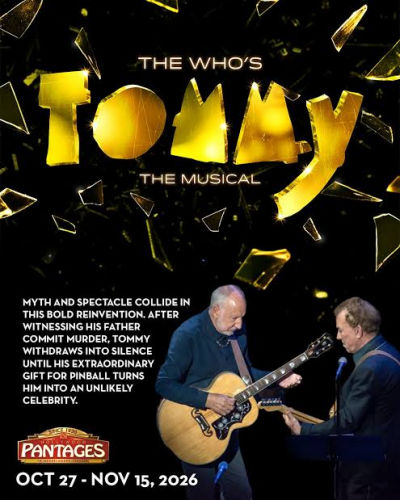
But this year, we saved ourselves hundreds of dollars (bags of candy have gone up in price) and put out “Closed for Halloween” signs, for we had our season tickets for “The Who’s Tommy” at Broadway In Hollywood/Hollywood Pantages. Alas, it seemed like lots of people decided that protection candy was more important, as the theatre was only about 40% full. Evidently, Halloween is a great night to find unsold seats at the theatre.
As for Tommy: It turns out its been quite a while since we last saw the show — 2008 at CSUN, to be precise. For those unfamiliar with the show, here’s some of what I wrote back then:
For those unfamiliar with the story, Tommy is the story of Tommy Walker. It begins with a musical prologue showing the meeting of his parents, and his fathers departure for the WWII front, including his capture and internment. Mrs. Walker takes a lover upon hearing that her husband didn’t return. When Tommy is four, his father returns finding his wife and her lover inflagrante, and shoots the lover while Tommy watches everything in a mirror. His parents tell Tommy that he heard nothing, saw nothing, and is to say nothing. Tommy withdraws into himself, and is for all intents and purposes deaf, dumb, and blind. As such, he is the target of molestation at the hands of his uncle and taunting and torture at the hands of his cousin. His only solace is pinball, and he is a pinball wizard. As such, he becomes popular and hero of the neighborhood lads. Back at home, all Tommy does is stare into the mirror. Desparately trying to reach him, his mother smashes the mirror, which frees Tommy. He leaves home, and the cure is considered miraculous. His uncle and cousin capitalize on his stardom, and Tommy gives in. When one fan rushes to the stage and gets beaten, he realizes the cost of his celebrity. He invites everyone to return home, and spreads the message that the true miracle is available to everyone: to see, hear, and feel other people, not withdraw inside themselves. Of course, the crowd doesn’t like this message, wanting instant salvation, and turns away from him. Tommy is left with his family, who embraces him.
Tommy started out as a themed rock album written by the Who in 1970. I first learned of some of the songs when I got the album Meaty, Beaty, Big and Bouncy when I was 12 or 13, as that album included “Pinball Wizard”. Back then, I thought it was heavy rock, and I was into folk. I’ve grown to appreciate the music since then.
Before I delve into this production, a few thoughts about the show in general.
First, this show centers about pinball. As such, one comes to the realization that (insert tone) “kids these days” have no idea what pinball is. When I was a kid — in fact, around the time that Tommy first was released by the Who — I would spend hours upon hours on the second floor of Music Odyssey on Wilshire Blvd in West LA playing pinball. Pinball is what kids did in the days before we had video games and computers. A mechanical game: put your quarter in a slot, and launch a silvered ball into a game field with bumpers and flippers and scoring mechanism. The object was to keep the ball in play as long as possible, earning score by launching the ball into things, and having the machine make loads of noises. You wanted to avoid a “tilt”: so called because people would lift machines to change the trajectory of the ball. A “tilt” would cause the machine to deaden the playing field, and you would lose that ball. Kids today have no idea what this is; the producers obviously didn’t either as they just represented the pinball machine with a table. If you want to learn pinball, I suggest you get to Las Vegas and go to the Pinball Museum. A much better way to throw your money away than slot machines.
Second, some of the themes of the show hit very differently in 2026 than they did in 2008 when I first saw it, and certainly differently than in 1992 when it was first on Broadway, and even more differently than in 1970, when the album was first released. Today, we understand PTSD and what it can do to the mind. That’s certainly at the heart of the Tommy story, but there was no way to really put that into words in 1970. The notion of sexual abuse of children and of bullying of children also hits very differently. Lastly, the whole cult of personality and worship of celebrity that is a key aspect of the second act of Tommy is far too common today, and I think we understand better the cost.
Now, turning to THIS production. A recent theatre review by Charles McNulty eviscerated The Music Man at CTG/Ahmanson Theatre, blaming the fact that it wasn’t an AEA (Actors Equity) production for poor acting. He compared it to community theatre. McNulty was wrong on both those points: Non-AEA doesn’t mean the acting is poor, and community theatre doesn’t imply bad. The 2019 production of The Music Man at 5-Star theatricals shows what community theatre, and a mix of Equity and non-Equity actors can do. Fault should be placed where fault is deserved: If acting is poor, then the fault isn’t the union status, it is the fault of the casting director (who picked the actors), and the production and tour directors (who are supposed to shape the acting in the show). Union affiliation is important, yes, but that’s to ensure actors get paid properly and have a safe working environment.
I bring up the McNulty review because I turned to the back of the program to see the AEA status of this show. Although the director is union (SDC) and the backstage and FOH employees are union (IATSE), this is not an AEA show. Yet, the problems with this show were not the actors or the performances themselves: they were strong, and the dancing was strong. But this show did have some problems, and I place the responsibility for those problems at the feet of the director. The director is the one responsible for the vision of a given production, and I feel the director, Des McAnuff (who was one of the original book authors), took the show in the wrong direction.
The problem, is I see it, was that he made the show far too abstract, and far too modern. Perhaps he was trying to reach the sensibility of “kids these days”. But he had a boxed-in set design for the tour that severely limited the view from the sides of the theatre (and not all theatres are narrow and long — some gain their large number of seats by being wider). He also had a design that was overly dependent on projections. Most set pieces were not realistic: they were abstract doors and tables. This heavy abstraction turned the focus away from the story and made it into a heavy dance piece. The dance was spectacular, yes, but the actual story gets lost. When you are dealing with a rock opera that wasn’t written as a musical (that is, the songs punctuate instead of advancing the story), having some realism is necessary to bring the story alive.
Further, the second act combined those projections with a heavy use of live video: video from the audience of the actors, projected behind the actors as news footage, video from actors onstage with hand-held cameras, again projected on stage; use of video screens to turn the mirrors into screens projecting images of different Tommy’s back at the live Tommy. This didn’t fit the years of Tommy, and the only real effective one was the mirror images. The live video projections were distracting and anachronistic.
The fault here lies with the directorial choices. Although the actors were not union, they were not at fault here. Their performances were strong.
In particular, I’ll note the performances of Collin Matthew Flanagan as Tommy and Mari Grossman as Little Tommy. For much of the show, they have a very hard job: being deaf, dumb, and blind. That means staring straight ahead and not reacting to the music or performances onstage, which requires a lot of restraint. They also sang very well, and Flanagan had a bit of a Pete Townshend look.
Other characters are onstage a lot less. Zach Fogel (who is a local boy, as I noticed stints at 3-D Theatricals and Candlelight Pavilion) as Captain Walker and Mia Bergstrom as Mrs. Walker were strong. Peyton Cassity was good as Uncle Ernie. I was less enamored with Kyle McFalls’ Cousin Kevin, as he overdid the accent.
Lastly: What the hell is a “Remote Swing”? It seems to me that if you are swinging into a performance track, you need to be onstage and not remote. There are no performers credited as “Remote Performers” for the “Remote Swings” to replace.
The ensemble was very strong, especially in terms of the dancing. Catching my eye was Tiyanna Gentry, who had a unique look and performance. But the characters were shifting so much, and the focus seemed more on the abstract dance, that isolating particular folks was difficult.
The Who’s Tommy continues at Broadway In Hollywood/Hollywood Pantages through November 15. Tickets are available through the Pantages website. If you enjoy the music of the Who, you’ll find the show a real trip. It really isn’t conventional music theatre, or what we think of as “rock opera” in today’s terms (Andrew Lloyd Webber, Jesus Christ Superstar, and Evita probably destroyed that).
Credits
The Who’s Tommy. Music and lyrics by Pete Townshend. Book by Pete Townshend and Des McAnuff. Directed by Des McAnuff. Choreography by Lorin Latarro.
Cast [underscores indicate “at our performance”; strikeouts indicate “not at our performance”; ↑ indicates “swung up”]: Collin Matthew Flanagan Tommy; Mia Bergstrom Mrs. Walker; Zach Fogel Captain Walker; Peyton Cassity Ensemble, Uncle Ernie; Kyle McFalls Ensemble, Cousin Kevin; Audry Fisher Ensemble, Sally Simpson; Mari Grossman Ensemble, Little Tommy; Kris Lyons Ensemble, Acid Queen; Amaya Adams Mariangeli Collado Ensemble, Nurse; Bo Bailey Ensemble, Officer, 1st Pinball Lad; Tiyanna Gentry Ensemble, Minister’s Wife, Mrs. Simpson; Chase Graham Ensemble, Minister; Trevor “Tjay” Groce Ensemble, Allied Soldier, 2nd Pinball Lad; Evan Hoefer Ensemble, Commanding Officer, Vendor, Mr. Simpson; Justin Lee-Price Ensemble, Hawker, Specialist; Greyson Taylor Ensemble, Lover, Harmonica Player. Swings: ↑ Mariangeli Collado Dance Captain; Josh Devine Asst Dance Captain, Fight Captain; Julia Martini; Albert Sterner. Remote Swings: Paul Tuaty, Hunter Lynn Luedde. Notably Mariangeli Collado and Josh Devine are understudies for the onstage band, something you don’t often see.
Music Department (🌴 indicates local): Pete Townshend Music and Lyrics; John Entwistle and Sonny Boy Williamson II Additional Music; Steve Margoshes Original Orchestrations; Rich Fox Additional Orchestrations; Ron Melrose Music Supervision, Additional Arrangements; Calvin Hitchcock Music Director, Conductor, Keys; Gregory Franz Assoc Music Director, Keys; Talia Rose Guitar; Cat Barker Bass; Kelvin Newell Drums; Randy Cohen, Cohen Keyboards LLC Keyboard and Drum Programming; Dana Haynes Ableton Designer; Ethan Deppe Assoc Ableton Designer; Cameron Rasmussen Guitar FX Programming, Additional Tracks; Anixter Rice Music Service / Russ Anixter Music Preparation.
Production and Creative: Pete Townshend Book; Des McAnuff Director, Book; Lorin Latarro Choreographer; David Korins Scenic Designer; Peter Nigrini Projection Designer; Sarafina Bush Costume Designer; Amanda Zieve Lighting Design; Gareth Owen Sound Design; Cassie J. Williams Hair and Wig Design; Steve Rankin Fight Director; The TRC Company Casting; Michael Bello Assoc Director; Charlie Munday Asst Director; Dee Tomasetta Assoc Choreographer; Sarah Parker Movement Associate; Jayden Dudley Production Stage Manager; Brooke Stevenson Asst Stage Manager; Work Light Productions General Manager; Port City Technical Production Management; Michael Coglan Company Manager; Bond Theatrical Booking and Marketing Direction; Marathon Digital Social Media; The Who Original Album.
Administrivia
I am not a professional critic. I’m a retired cybersecurity professional, a roadgeek who does a highway site and a podcast about California Highways, and someone who loves live performance. I buy all my own tickets, unless explicitly noted otherwise. I do these writeups to share my thoughts on shows with my friends and the community. I encourage you to go to your local theatres and support them (ideally, by purchasing full price tickets, if you can afford to do so). We currently subscribe or have memberships at: Center Theatre Group/Ahmanson Theatre; Broadway in Hollywood/Pantages Theatre; Pasadena Playhouse; The Soraya, Chromolume Theatre, and 5-Star Theatricals.
Want to find a show: Check out the Theatre Commons LA show list. Other good lists are the Theatre in LA listings; the TodayTix listings; OnStage 411 (use the “shows” drop down); and Theatermania. If you are looking for discount tickets, TodayTix (unlike their predecessor Goldstar Events) doesn’t handle the small theatres in LA. Luckily, Theatre Source LA has a new initiative: StageRushLA for discount tickets.
Upcoming
Key: 🎭 Theatre / 🎼 Music /  Other Live Performance – Next 90ish Days (🎫 indicates ticketing is pending).
- November: 🎭 Things are Looking Up at the Binge Festival of Free Theatre/Santa Monica Playhouse (Livestream); 🎭 Passing Strange at Pasadena Playhouse; 🎭 Oh Mary at CTG/Ahmanson; Dance Theatre of Harlem at The Soraya; 🎭 Every Brilliant Thing at Olive Branch Theatricals; 🎭 Road Show at Chromolume Theatre; 🎭 Destiny of Desire at CTG/Taper.
- December: 🎭 Candide at LA Opera; 🎭 Big Fish at Conundrum; 🎼 Spanish Harlem Orchestra at The Soraya; 🎭 Christmas Carol Goes Wrong at CTG/Ahmanson.
- January: Right now, January is open. I’m interested in Brian Stokes Mitchell at Broad Stage, but the tickets available currently are too expensive.
- February: 🎭 Dead as a Dodo at Pasadena Playhouse; 🎼 Terence Blanchard & Ravi Coltrane at The Soraya; 🎼 The Best Is Yet to Come: José James Sings Frank Sinatra at The Soraya; 🎭 Fiddler on the Roof (Yiddish) at CTG/Ahmanson; 🎼 Emmet Cohen Trio with Ekep Nkwelle at The Soraya
Other shows will certainly be added (especially in January) as they are discovered.
