 This week has truly disturbed me. I’m not specifically talking about the specific people in the news and what they have done (although that’s been pretty horrific). Rather, I’ve been talking about what I’ve seen on social media in response — and it truly is frightening me. If we look back at the American Civil War in the 1860s, the groundwork for it was laid many years before — some argue it was laid at the time at the founding of this country, and the specific items that led to the actual Civil War were triggered by a number of Supreme Court cases, including the Dredd Scott decision. But that Civil War — horrible as it was — had one distinct advantage. The ideological lines roughly could be drawn as geographical lines. There were clear areas that held one view strongly, and clear areas that held a different view strongly. That led to secession and a traditional ground war.
The foundational problem that led to the Civil War is still around. There is a divide in this country and it is growing, a divide created by some fundamental constitutional decisions. The wounds from the first Civil War are festering and malingering. This week — again, a battle over a Supreme Court justice, and his positions on a number of decisions — are adding fuel to the fire. But unlike the last Civil War, this one will not have clean geographic battle lines. There is no territory to secede, no traditional armies to form, no place for those armies to line up and take aim at each other (except on social media). There is still anger, there is still brother against brother, but this time it is at the level of Shia vs. Sunni in the Middle East: a block by block, house by house, room by room division that can only be fought in the most dangerous way: through propaganda, through terrorism, through mess shootings, through IEDs. It is a something that is not fought by formal armies, but by lone angered crazies, trying to bring a point home, so desparate for their side that they will do anything.
As we have seen, such a war is dangerous not only for the civilians in the middle, but it is a war where there is no clear victory and no one to surrender. It is a war that does not win a cause and destroys a nation. It is a war that stops only when the people arise and say, “Enough!”, and either convince the losing side to change their mind (unlikely) or find a pocket of the country where they can be kicked out to, to be isolated and live the way they want. The latter, although *a* solution, is not *the* solution. Further, the solution is not legislating one side’s goal, for that just kicks and anger and resentment down the road, to let it fester and grow. The solution may not be compromise either, for that doesn’t resolve the fundamental problems. Ask yourself: Did the Civil War solve the race problems in America? Did the Civil Rights Act of 1965 solve the problems?
Here’s the divide as I see it.
On one side you have what I we’ll call the “Blues”: using the name Democrat is wrong, because the coalition is broader than that; the name Progressive is wrong because of the pejorative nature of the term; the term Liberal is wrong because it has been coopted into an curse word. These folks are libertarian in the social sense: what people do is there own business, and someone else’s beliefs should not be forced upon them. They fundamentally respect the rights of others in a similar way — and argue against discrimination or privilege based upon characteristics — sex, skin color, orientation, gender, social status, religion, and many more. They care about others, often at a personal cost to themselves (and often, they are willing to take burdens upon themselves, such as taxes, to help others). That does not mean they are fiscally irresponsible — they don’t want to spend just for spending’s sake — there needs to be an outcome. They are not universally against war, but I do think there is a belief that when war is waged, it must be just and for the right purpose, and have a clear victory point. They are a bit more against the war machine — the complex that supports war and tends to want to feed itself — and would rather not only those funds, but the talent and intellect to be used for productive purposes and to benefit society (as was done with the DARPANet). They are distinctly against inherit and inherited privilege, believe in consent and the right for the individual to dictate what is done regarding their bodies, and they demand respect for themselves as individuals.
On the other side, you have a few of the same characteristics† — a demand for respect, calls for fiscal restraint. Let’s call this side the “Reds”, for it isn’t the traditional Republican Party, and it has gone beyond the Tea Party. The term Conservative is wrong because it too has both become pejorative and coopted, and to call it the party of the Privileged Old White Men is wrong because there are other sexes and races represented. But it does appear to be a party of Fundamentalist beliefs (including evangelical), and all that goes along with them. It does appear to be a party that believes in fixed social and economic strata, and that people have their places therein. It is the party that believes in the divide between the 1% and the rest, in the divide between black and white, man and women, and that each have their place in society. It is a party that believes it is acceptable to mandate their fundamentalist views on people that believe differently (although, arguably, they view what the Blues are doing as exactly the same thing). Thus, if they believe life begins at conception, everyone has to hold that view. If they believe that certain characteristics give an entitlement for a particular behavior and privilege, then that is how it must be. They are willing to fight war — and not only have the guns, but are willing to use them against the Blues whenever and whereever necessary. They don’t understand the positions that the Blues take, and weaponize that mis-understanding. This week was a good example of that: when the Blues get concerns about sexual assault and their victims, the Reds threaten to weaponize sexual assault claims — real or imagined — against the Blues (and that has started). The Reds will figure out a way to weaponize any freedom, and use it to destroy and divide — freedom of speech, freedom of the press, freedom of religion, the 2nd Amendment. While the Internet wasn’t designed for this purpose, they’ve weaponized it as well, using it as a way to amplify their voices, spread propaganda, engender distrust, fan the flames of resentment, and sow the seeds of discontent. They’ve used it to find others with similar feelings, and they’ve begun to organize (and, in response, the Blues have used the Internet for the exact same thing).
——————
†: Admittedly, this is from my perspective as a Blue, and thus is a bit skewed, and perhaps a bit pejorative. But that is (at least) the perception I have, so if someone wants to clarify or correct my characterization of the Reds, please do so.
This divide is real. The adherents are intransigent. There is more similarity between the two sides than they would admit about wanting to legislate their worldview on those who believe otherwise. The worldviews may, indeed, be incompatible. But both sides believe in their hearts and mind, with 100% of their being, that they are in the right. If there is reconciliation, it is only temporary. Both take advantage of any tool that is given, and use it in the worst way.
[ETA: One of the things leading to that is inconsistency. If some particular action is done, it needs to be done independent of whether it is your candidate or not. So, if you establish the tradition of not considering a Supreme Court candidate nominated by the other side in an election year because — you know, election — then don’t be surprised when the other side wants the same delay when your side nominates a candidate. To not delay shows the original delay to be weaponized political ploy. Or, to use the Ford case as an example, if you bring up sexual harrassment charges, then you must be consistent. Don’t stop the investigation if the accused candidate withdraws the nomination — continue to investigate and either confirm the charges, or clear the name and go after the false accuser. To do anything else demonstrates it was just a political ploy weaponized. Further, you need to be willing to believe as true and investigate any claim made against your side as well. The issue is believing the claim, investigating it well, and taking actions based on the findings — whoever the claim was against. If you investigate every little claim of bad legal behavior when your opposition is in office, you need to be willing to do the same level of investigation when it is your guy behaving badly. One of the best tools to close the divide is consistency.]
The most disheartening thing is that I can’t see a solution. The anger will grow and grow on both sides until it erupts in warfare. I like to point out one of my favorite books, The Late Great Days of the State of California by Curt Gentry — about the election of Ronald Reagan in 1965 in California — as a warning shot of what was to come. The seeds of this war and anger were planted by the election of Reagan to the Presidency in 1986, and the subsequent election of Bill Clinton in 1992. Each set the anger in motion; each was a dividing point for the country. The election of Bush 43 and the Supreme Court intervention in Florida that gave him his office and the subsequent swing to Obama was the fertilizer, and the election of Trump has combined the ingredients into a weapon.
It’s not pretty out there, except for being pretty disgusting. What is worse: I don’t see an answer. It just leaves me very worried and scared for our future.
If you see a reasonable answer and a way to fix this before it becomes worse, please share it.


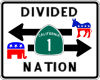 There seems to be two worlds out there. In one world — let’s call it the red world — the only thing standing between us and death and destruction would be a physical wall on the Southern border. In the other world — let’s call it the blue world — the fear leading to the call for the wall isn’t there, and there is the belief that other mechanisms will suffice. The red world believes that the blue world want “open borders”, when that isn’t what they are saying. Neither side is listening to the other, and the government is (partially) shutdown. I’m a believer in risk management and risk reduction, and so I would like to offer some thoughts on the subject:
 Back when I was in college, one of the games we had in the UCLA Computer Club was Flying Buffalo’s Nuclear War. This is a card game where the players launch missiles at each other. If an opponent wipes you out with missiles, you can attempt to shoot off whatever is left in your arsenal to wipe them off the face off the map. Good times! But the game had a catch: If you lost your population due to a well played propaganda campaign, there was no chance of a final strike. You were wiped off the map, without retaliation.
 I woke up
  Recently, we had to replace the fill valve in our toilet. We went to
  A friend of mine recently posted a great summary of what being a liberal means, written by Larry Allen. It struck very close to home, as I was recently accused of being a socialist, just because I’m a registered Democrat. So I’d like to adapt Allen’s piece to detail my views. For the record, “
 In Judaism, there is a prohibition against Lashon Hara, disparaging speech. Gossip and slander are serious sins in Judaism. Judaism forbids causing any deception or embarrassment through speech; it is forbidden even if the statement is true. There are just a few exceptions. The following is an excerpt from